Population Scale Ideas · Idea #1 · Home services
Twelve years. ₹2,385 crore.
One giant. No equal challenger.
Urban Company taught India to book a plumber, a beautician and an AC mechanic on an app. That lesson took a decade and thousands of crores. Every great Indian market ends up with two giants. Home services still has one. This is the open case for the second.
By Govind Agrawal, Founder & CEO, Anaxee · Figures from Urban Company’s public filings
Chapter 1 · The story
Three engineers, one ordinary problem
In December 2014, three young engineers registered a company in Delhi called UrbanClap. Abhiraj Singh Bhal had studied at IIT Kanpur and IIM Ahmedabad and worked at Boston Consulting Group. Varun Khaitan, also from IIT Kanpur, had worked at Qualcomm and BCG. Raghav Chandra had studied at UC Berkeley and worked at Twitter.
The problem they picked was not glamorous. Finding a reliable electrician, plumber or beautician in an Indian city meant asking neighbours and hoping. Prices were a negotiation, quality a gamble, and the person at your door a stranger.
They set out to change both sides at once: make customers trust a stranger booked through an app, and turn lakhs of independent workers into trained, rated, insured professionals. It took twelve years, a rebrand, two exited countries and one of the largest cheques in Indian consumer internet. And it worked.
That is exactly why the next one will be cheaper. The hardest, most expensive lesson — teaching a country a new habit — has already been paid for.
Dec 2014UrbanClap incorporated in Delhi
2015Series A, A1 and B — about ₹221 crore in the first year (SAIF/Elevation, Accel, Bessemer)
2018Launches in Dubai — the first step abroad
2019Skilling partnership with NSDC
2020Rebrands to Urban Company; COVID shuts homes to visitors
2021Series F — about ₹1,410 crore in one round (Prosus, Dragoneer, Wellington and others)
FY23–FY24Exits Australia and the US; cities trimmed from 62 to 51
FY25First profitable year; the India core business turns profitable
Sep 2025Lists on NSE and BSE
Oct 2026Board approves a fresh raise of up to ₹2,500 crore
Chapter 2 · What they built
A habit, a workforce and a brand
customers who booked in FY26
of services and products booked in FY26
Indian cities, ~12,000 micro-markets
of India bookings from returning customers
monthly active service partners, FY26
average monthly take-home for an active partner (9M FY26)
of customer queries now solved by AI chat
people have used it at least once (to Dec 2024)
LATEST QUARTER · Q2 FY27 (JUL–SEP 2026)
bookings in the quarter, up 39%
cash and treasury at quarter end
fresh raise approved by the board
InstaHelp loss in one quarter
Chapter 3 · What it cost
Not every rupee was productive. That’s the point.
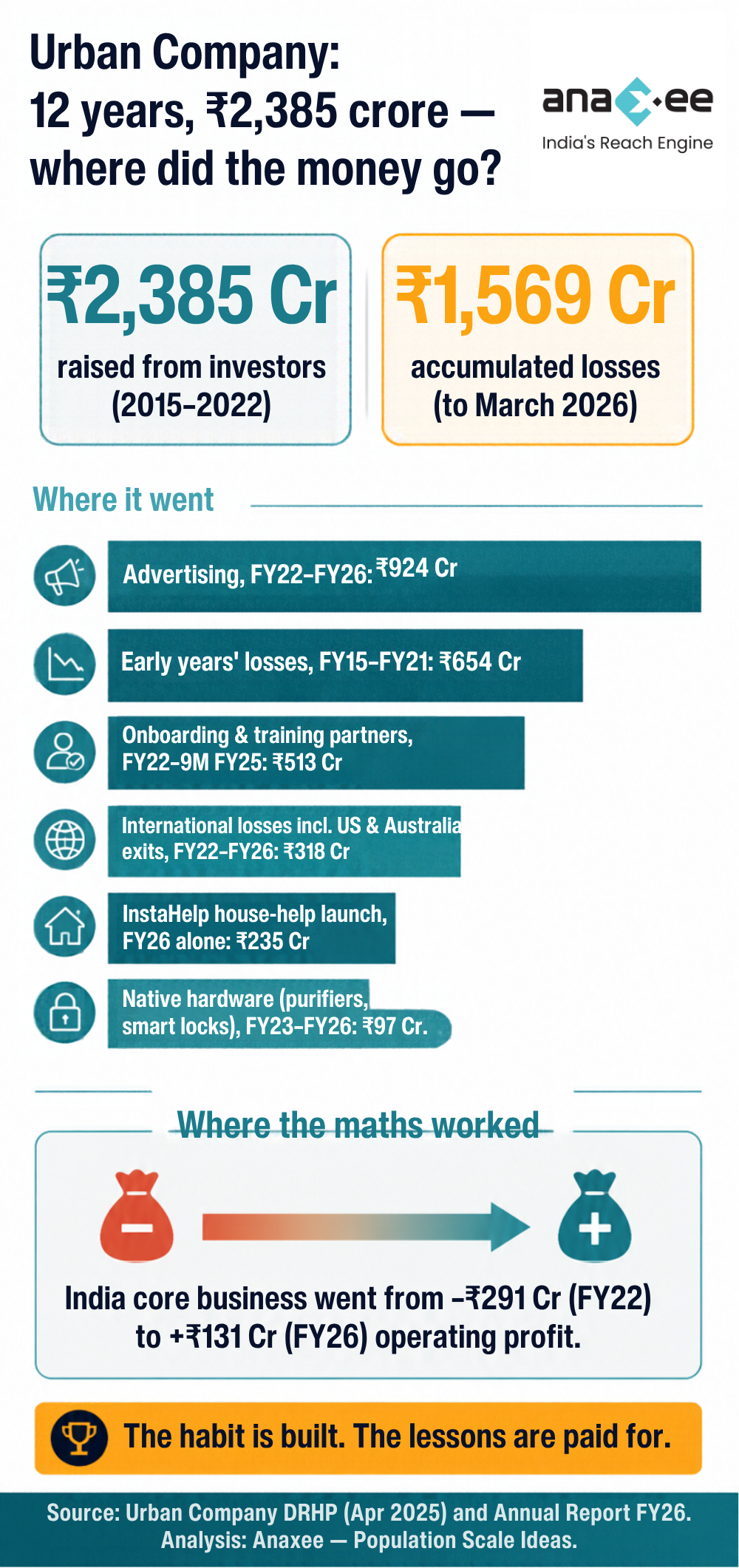
Investors put about ₹2,385 crore into Urban Company before its IPO. By March 2026 it had booked ₹1,569 crore of accumulated losses. About ₹654 crore went in the early years alone — the price of persuading India that a stranger booked on an app can be trusted inside the home.
Some of the rest bought lasting things: a brand, trained partners, technology. Some bought lessons a newcomer never has to pay for again.
Advertising, FY22–FY26₹924 Cr
Onboarding & training partners, FY22–9M FY25₹513 Cr
International losses incl. US & Australia exits, FY22–FY26₹318 Cr
InstaHelp house-help launch, FY26 alone₹235 Cr
Native hardware (purifiers, smart locks), FY23–FY26₹97 Cr
Chapter 4 · Where the maths worked
The core Indian business works. The experiments didn’t.
Look at operating profit by business and a clear picture appears. The Indian home-services marketplace went from a ₹291 crore loss to a ₹131 crore profit in four years. The money that leaked went into new countries, hardware and new verticals.
India Consumer Services, Adjusted EBITDA (company-defined, non-GAAP). Source: Urban Company DRHP; Annual Report FY26.
Chapter 5 · Why now
For every Coca-Cola, there is a Pepsi
The habit already exists
Over 13 million people have booked Urban Company at least once. Nobody needs to be taught again.
The playbook is public
A listed company discloses which categories repeat, which cities pay and which experiments failed.
AI changes the cost base
Support, quality checks and code are now largely AI-run — Urban Company says so itself. A new entrant starts there.
The market is still under 1% online
A ₹5 lakh crore home-services market, over 90% unorganised. There is room for two.
Investors are already moving
In instant house help, Snabbit raised about $112 million in 15 months. Urban Company’s core — repairs, cleaning, beauty — still awaits an equal.
The incumbent is spending on a new front
Urban Company lost ₹174 crore on InstaHelp in a single quarter and is raising up to ₹2,500 crore more.
Chapter 6 · The challenger plan
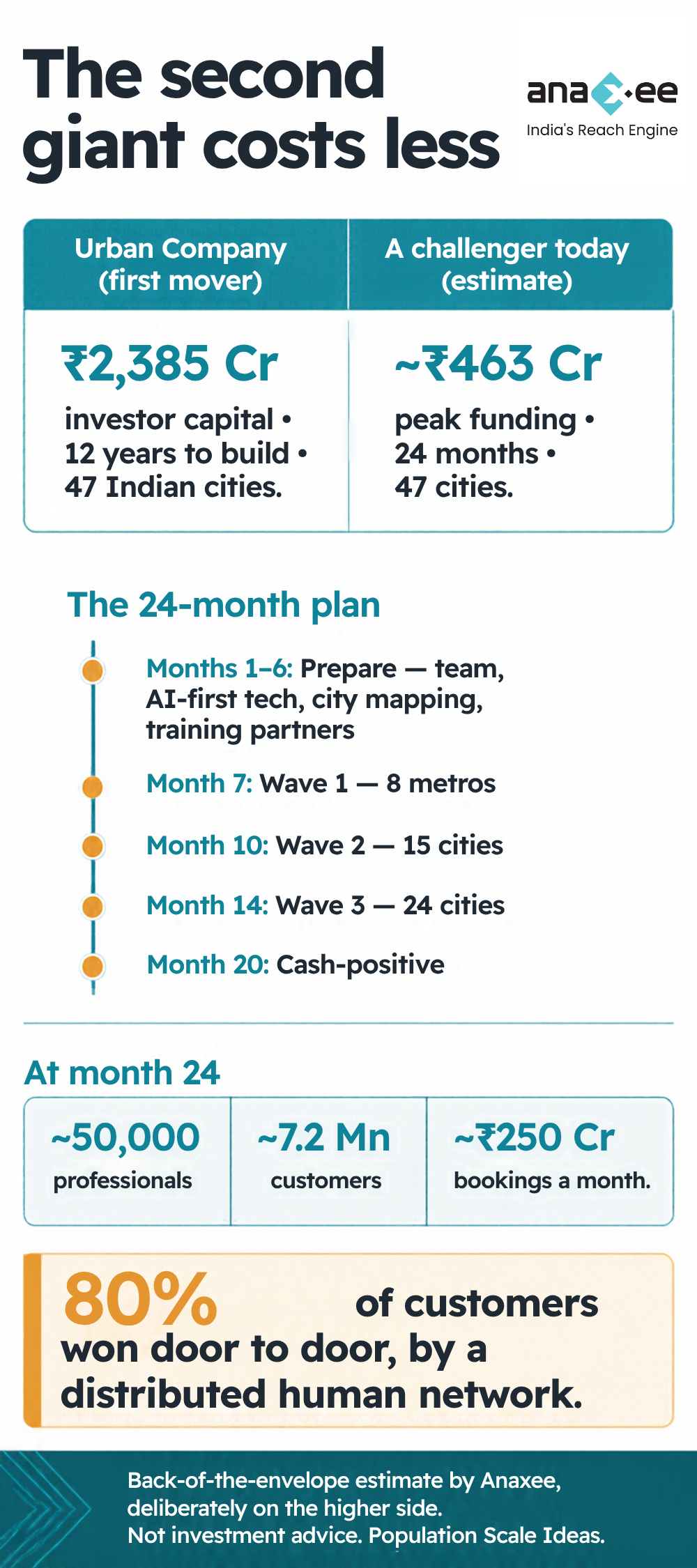
Twenty-four months, city by city
Prepare
Team, AI-first tech, city-by-city market mapping, training partners
Wave 1 · 8 metros
~3,000 professionals per metro, onboarded and trained in steps
Wave 2 · 15 cities
~1,100 professionals per city
Wave 3 · 24 cities
47 cities live — the same Indian footprint as Urban Company
Customers won on the ground
80% door to door and at housing societies, 20% online. Online must always cost less than the field.
Professionals invest in themselves
Co-paid training, earned back after 30 jobs. Kits bought on easy EMI. Only serious partners join.
A better deal for partners
A 22% platform fee against Urban Company’s 28.3% — the professional keeps more of every job.
Chapter 7 · The numbers (back of the envelope)
A fifth of the money. Two years, not twelve.
investor capital, 2015–2022
peak funding, cash-positive from month 20
At month 24 the challenger runs about 50,000 professionals and 7.2 million customers across 47 cities, with bookings near ₹250 crore a month — about three-quarters of Urban Company’s Indian core business today.
Winning customers (80% on the ground)₹322 Cr
Launch offers (“3 services for ₹500”)₹156 Cr
Training (after partner co-pay)₹63 Cr
Head office, 60 → 250 people₹57 Cr
Technology infrastructure₹44 Cr
Brand, city teams, early earnings support, other₹139 Cr
20% buffer — kept on the higher side₹156 Cr
Total spend over 24 months₹937 Cr
Earned along the way (22% fee, kits, consumables)₹540 Cr
An estimate for discussion, deliberately on the higher side. Not investment advice.
Chapter 8 · How it gets built
A distributed human network plus technology
Platforms are built in apps, but they are won on the street. The expensive part of this business is not code — it is reaching lakhs of professionals and millions of homes, one lane at a time, and checking that every job was done right.
Map every city
Micro-markets, demand, and the unorganised professionals already working there.
Find and onboard professionals
Field drives to register skilled people, then route them to training partners.
Win homes door to door
Gig workers install the app and land the first booking, society by society.
Check with AI and live data
Geo-tagged photo proof, AI quality checks and a live dashboard for every city.
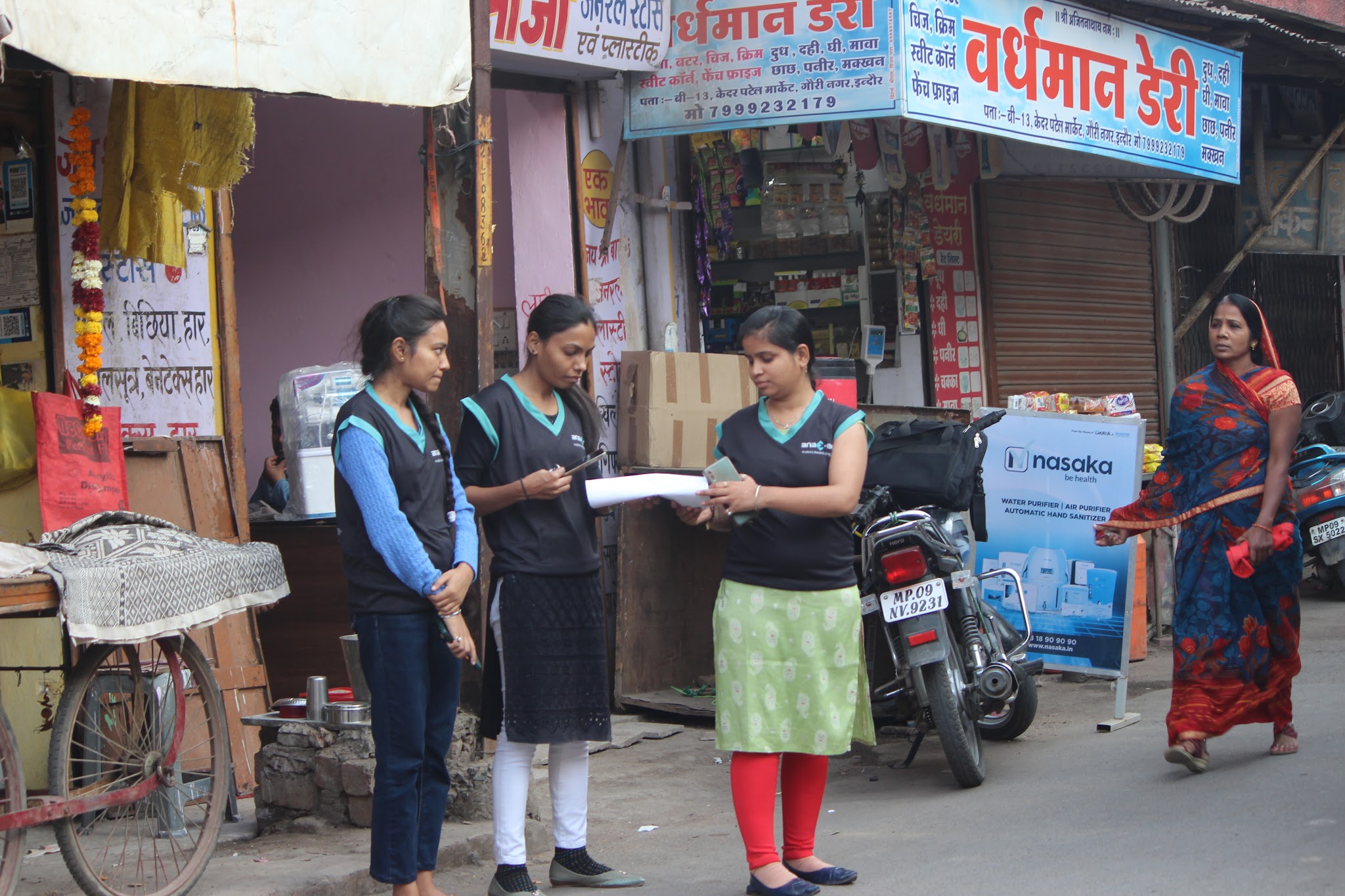
This way of working belongs to no one. Anyone can build it. Anaxee has simply been doing it for ten years — with 40,000+ Digital Runners across a network reach of 540 districts — and will share how.
10 years
Chapter 9 · Who will build it?
The habit is built. The playbook is public. The fight hasn’t started.
Founders
You don’t need ten years. You need the will, a sharp team and the ground.
Investors
The IPO gave you the full model. The second giant is the bet still open.
Corporates
Appliance makers, quick-commerce and consumer platforms already own the customer.
Sources: Urban Company Limited — Draft Red Herring Prospectus (28 Apr 2025); Annual Reports FY25 and FY26; Annual Business Summaries FY23 and FY24; Q2 FY27 results press release (investorrelations.urbancompany.com). Market figures in those filings come from a Redseer report commissioned by Urban Company. Snabbit funding: Entrepreneur India, May 2026.
Independent analysis based on public filings. Not affiliated with or endorsed by Urban Company Limited. Not investment advice. Challenger figures are Anaxee’s back-of-the-envelope estimates.