BLOG
Data-Driven Decision-Making: Why Leaders Are the Last to Know
Here is a pattern you can find in a failing company, a wasted government scheme and a lost election, all at once. The person in charge was not lazy or stupid. They were simply far — far from where the work actually happened — and everything they knew about the ground had passed through other people first. Each of those people had a reason to round the truth up. By the time it reached the top, the fog was complete. The decision that followed was made in that fog.
This is the most under-rated problem in management, in governance and in politics, and it is the same problem in all three. Call it the distance problem. Understanding it — and knowing what actually closes the distance — is, in our view, the real reason some organisations and some governments are so much more productive than others.
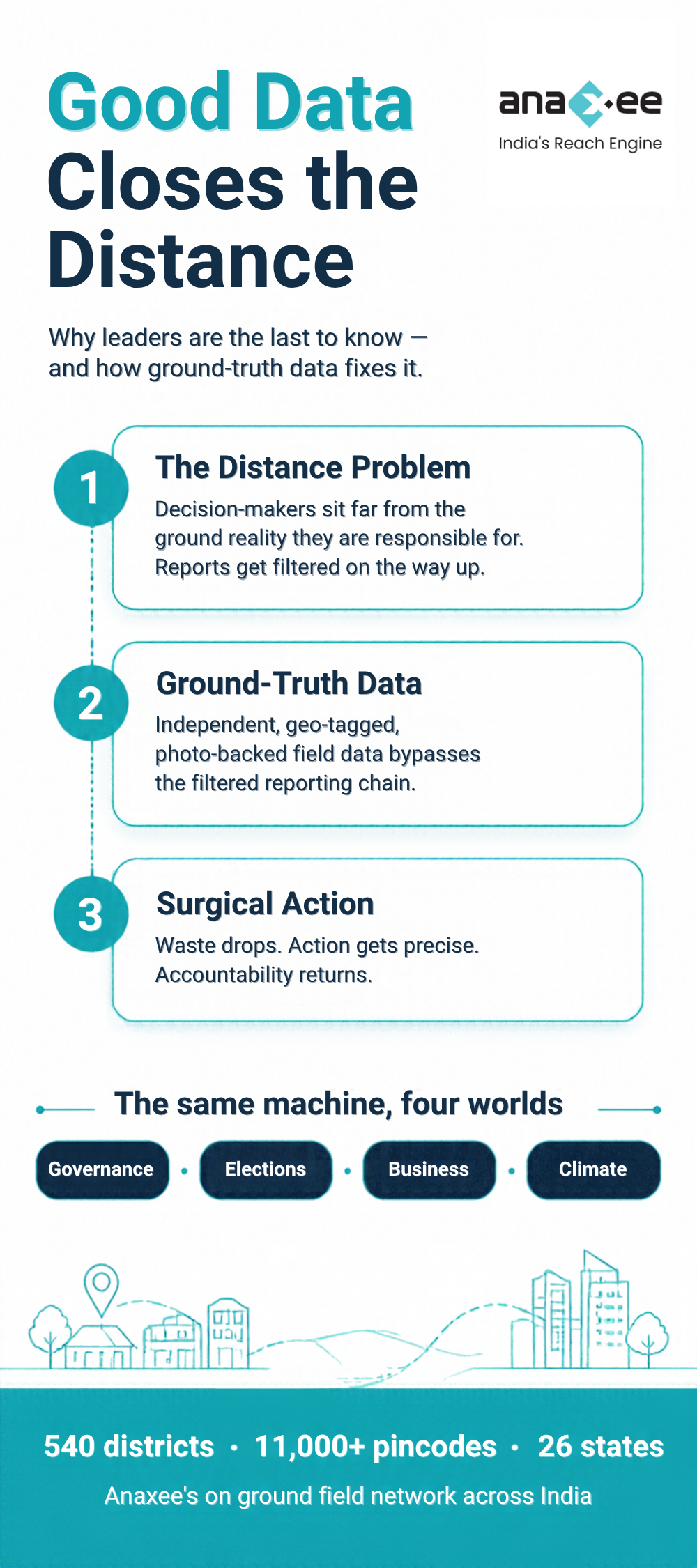
The distance problem
Every leader is responsible for a reality they cannot personally see. A retail chief answers for what happens in five thousand shops she will never walk into. A welfare minister answers for benefits reaching villages he will never set foot in. A candidate answers for the mood of millions he will never meet. None of them can be everywhere, so they rely on a chain of people to tell them what is going on — area managers, field officers, party workers, distributors, contractors.
The trouble is that every rung of that ladder has an interest in how the truth looks from above. The weak store does not want head office to know it is weak. The officer wants the scheme to look like it is working. The local worker wants the candidate to think the booth is safe. Nobody has to lie outright; they just each shade the picture a little in their own favour. Stacked up over five or six rungs, a lot of small shadings become a completely wrong picture. Bureaucracy and office politics are not side effects of this problem — they are the problem. Red tape, siloed information and competing interests are exactly what turn a clear ground reality into fog on the way up.
What actually closes the distance
The fix is not more reports, and it is not a prettier dashboard full of vanity numbers. It is ground truth: a direct, independent read of what is actually happening on the ground — captured at the source, with a time and a place attached, by someone who has no stake in making it look good. The two words that matter are direct and independent. Direct, so it did not climb the ladder and get shaded on the way. Independent, so the person collecting it is not the same person being judged by it.
When a leader can see the ground that way, three things change — and they are the same three things whether you run a company, a state or a campaign:
The same machine, four different worlds
What makes this idea worth writing down is that it is not really four ideas. It is one capability — trustworthy ground truth — doing the same job in four fields that rarely get discussed together:
| Field | The distance | What ground-truth data unlocks |
|---|---|---|
| Governance | A government cannot see every village its schemes are meant to reach. | Welfare that actually lands on the right people; money redirected from show to substance. (Estonia, India’s Aspirational Districts, Togo’s data-targeted cash transfers.) |
| Elections | A campaign cannot personally hear millions of voters. | Hearing the ground booth by booth, so a candidate plans with reality instead of noise. (Obama 2012; India’s booth-level campaign data.) |
| Business | Top management cannot watch every shop, plant and market. | An un-spun view of the market, past the sales team’s own reporting line. The boss stops being the last to know. |
| Climate | A funder cannot see whether a distant tree actually survived. | Claims that can be measured and trusted instead of greenwashed — the difference between a pledge and proof. |
In each case the enemy is the same: distance, dressed up as hierarchy. And in each case the thing that beats it is the same: data that comes straight from the ground and owes nothing to the people being measured. We will take each of these four worlds apart in its own piece — what the evidence actually shows, and where it has gone wrong — but the thread running through all of them is this one.
Why this is really a productivity story
Strip away the fields and this is, at bottom, about productivity. Whoever can see reality clearly and act on it quickly will out-perform whoever is deciding in fog — every time, in any domain. A company that can see its own market makes fewer expensive mistakes. A government that can see its own programmes spends public money where it changes lives instead of where it photographs well. A campaign that can hear its own voters stops wasting effort on the already-decided. The gap between the two is not talent. It is the quality and the honesty of the information reaching the top.
That is also where the hard part lives. The analysis is rarely the bottleneck — there is no shortage of people who can read a chart. The bottleneck is whether the data underneath the chart is true: whether it came from the ground or from the ladder. Getting trustworthy data out of thousands of scattered places — villages, shops, farms, booths — is a genuinely hard, physical problem, and it is the one most organisations quietly skip. It is also, as it happens, the problem we spend our days on.
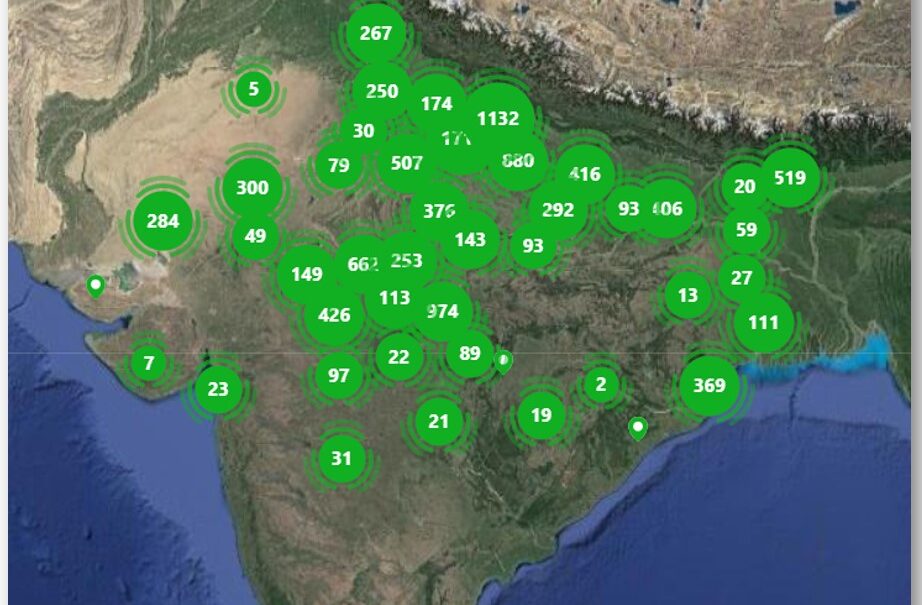
A note on where we come from: Anaxee runs an independent, tech-enabled field network across India — 540 districts, 11,000+ pincodes, 26 states — built to collect exactly this kind of ground truth and put it on a decision-maker’s dashboard. We write about this because we see the distance problem every day, from the ground up. If the idea is useful to you, the rest of the series goes field by field.
Frequently asked questions
What is data-driven decision-making, in plain terms?
Why are leaders often the last to know?
How does data improve governance and public services?
Is data useful in elections and politics?
Why is “ground truth” harder than it sounds?