BLOG
Data-Driven Election Campaigns: How Campaigns Hear the Ground
Every election is, underneath the noise, a distance problem. A candidate is asking to represent hundreds of thousands — sometimes tens of millions — of people they will never personally meet. The old way of bridging that distance was instinct: the seasoned local leader who “knew the mood.” Sometimes they were right. Often they were telling the high command what it wanted to hear. Data-driven campaigning is the attempt to replace that single filtered opinion with something closer to what people on the ground are actually saying.
This is a neutral capability, like a telephone or a printing press. It is used by campaigns across the political spectrum, in India and around the world. Here is what it actually does, the real cases that made it famous, and the honest line between listening and manipulation.
What data actually does for a campaign
The popular image — shadowy consultants “micro-targeting” voters — is the smallest and most controversial part of the job. The larger, more mundane reality is four things:
Three cases that defined the playbook
| Campaign | What they did | The lesson |
|---|---|---|
| Obama 2012 (USA) | Built a large in-house analytics team that modelled the electorate person by person and tested messages relentlessly — the operation journalists nicknamed “the Cave.” | Showed that disciplined data and experimentation, not just advertising spend, could drive turnout and targeting. |
| Indian booth-level data operations | Major Indian parties built booth-level databases and volunteer apps to track issues, workers and turnout at the most granular unit of the Indian electoral system. | Proved the same logic works at India’s scale — the booth, not the constituency, is the real unit of a ground campaign. |
| Professional poll strategists (e.g. IPAC) | India’s best-known campaign strategists built their reputation on large-scale ground listening — door-to-door surveys and feedback — over pure number-crunching. | Their own repeated message: ground listening beats armchair analytics. Data guides, but the signal has to come from real people. |
These are documented public cases, described here to explain the method — not an endorsement of any party, candidate or consultant. The common thread is not ideology. It is that each one tried to replace a guess about the voter with a measurement of the voter.
The dark side — and the honest line
No piece on this topic is complete without Cambridge Analytica, the firm that harvested Facebook data without consent to build psychological profiles for political targeting. It is the cautionary tale for good reason: the same techniques that let a campaign listen can, without consent and transparency, be used to manipulate. The problem there was never “data.” It was data taken without permission and used in the dark.
The honest line is consent and transparency. Field data gathered openly — people knowingly answering a surveyor, aggregated to understand what a community wants — is democratic listening. Data scraped covertly to psychologically target individuals is not. A healthy democracy does not ban the telephone because of the scam call; it insists the call be honest about who is calling and why.
Where an independent field layer fits
Most of what a serious campaign needs from data is not exotic modelling. It is trustworthy, verifiable ground information at scale: honest issue surveys, booth-level reality checks, and verification that the organisation on paper exists on the ground. That is a last-mile data-collection problem — the same one that shows up in governance and business.
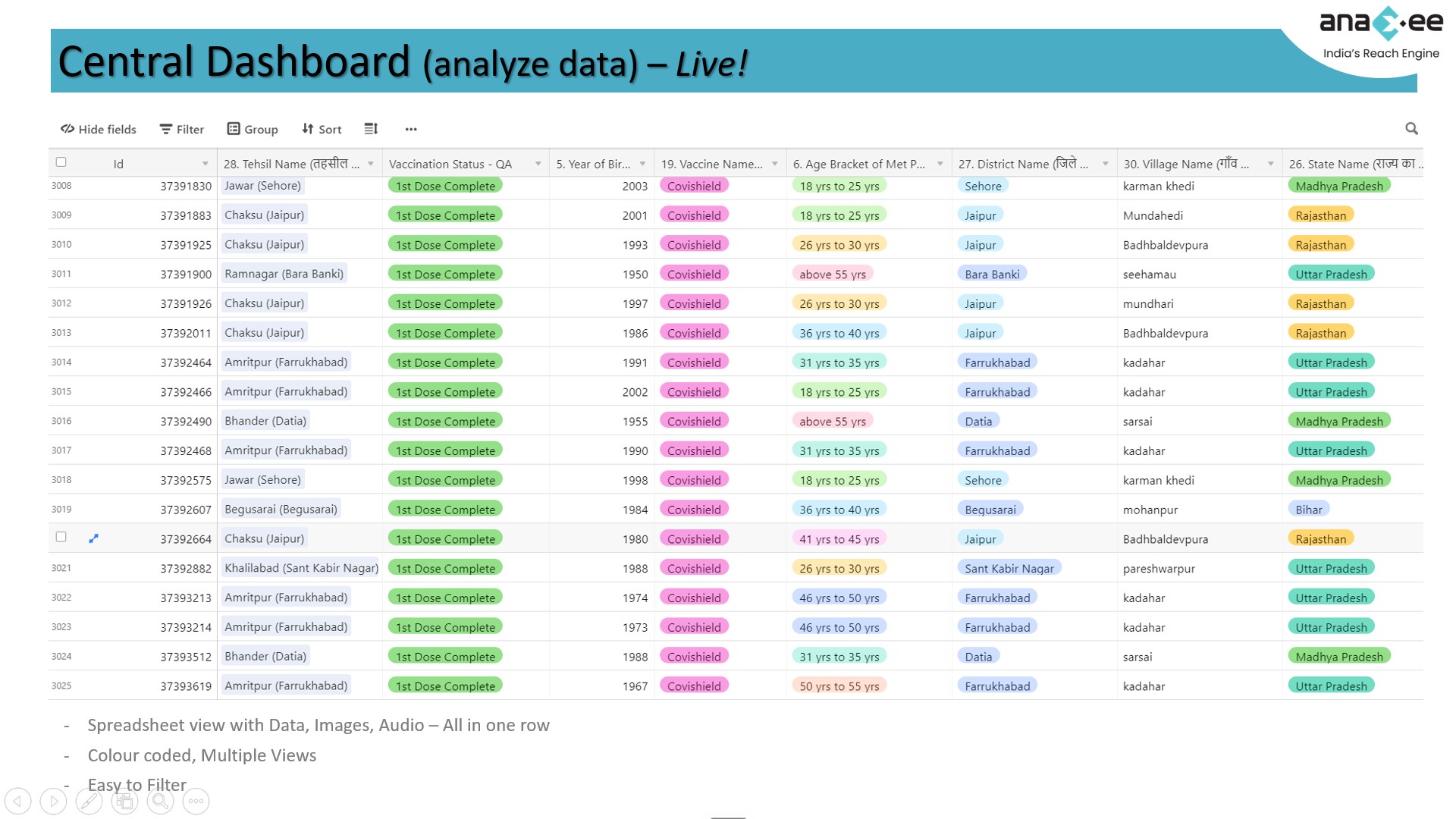
Anaxee operates as a neutral field-data and verification layer: a tech-enabled network of on-ground “Digital Runners” across 540 districts and 11,000+ pincodes in India that can collect geo-tagged, time-stamped survey and verification data, and feed it into a dashboard a decision-maker can actually read. The posture is deliberately simple — it is the layer that collects and verifies ground data; it does not run the campaign, take sides, or sit in the strategist’s chair. The data is the product; the decisions belong to the people accountable for them.
Need verified ground data at scale — issue surveys, field checks, independent verification across districts? That neutral collection-and-verification layer is what we do.
Frequently asked questions
How do political campaigns use data to win elections?
Is data-driven campaigning the same as manipulation?
What are real examples of data in elections?
Does Anaxee work for political parties?