Population Scale Ideas / Idea 01
Idea 01 · Home services marketplace
What Urban Company built in eleven years, a challenger can build in two.
Urban Company spent eleven years teaching India to book a plumber on an app, and about ₹2,385 crore of investors’ money doing it. Every lesson is now public, in its own filings. Here is the plan for the second one: about a fifth of the money, and two years instead of eleven.
Same 47 cities. A fifth of the money. About a sixth of the time.
Left: Urban Company Annual Report FY26 and prospectus. Right: Anaxee’s draft estimate, with costs kept on the higher side. It is a plan, not a forecast.
Latest filing · July to September 2026
Source: Urban Company Q2 FY27 results and shareholders’ letter, 16 October 2026. The raise is subject to shareholder approval.
Why a challenger
For every Coca-Cola, there is a Pepsi
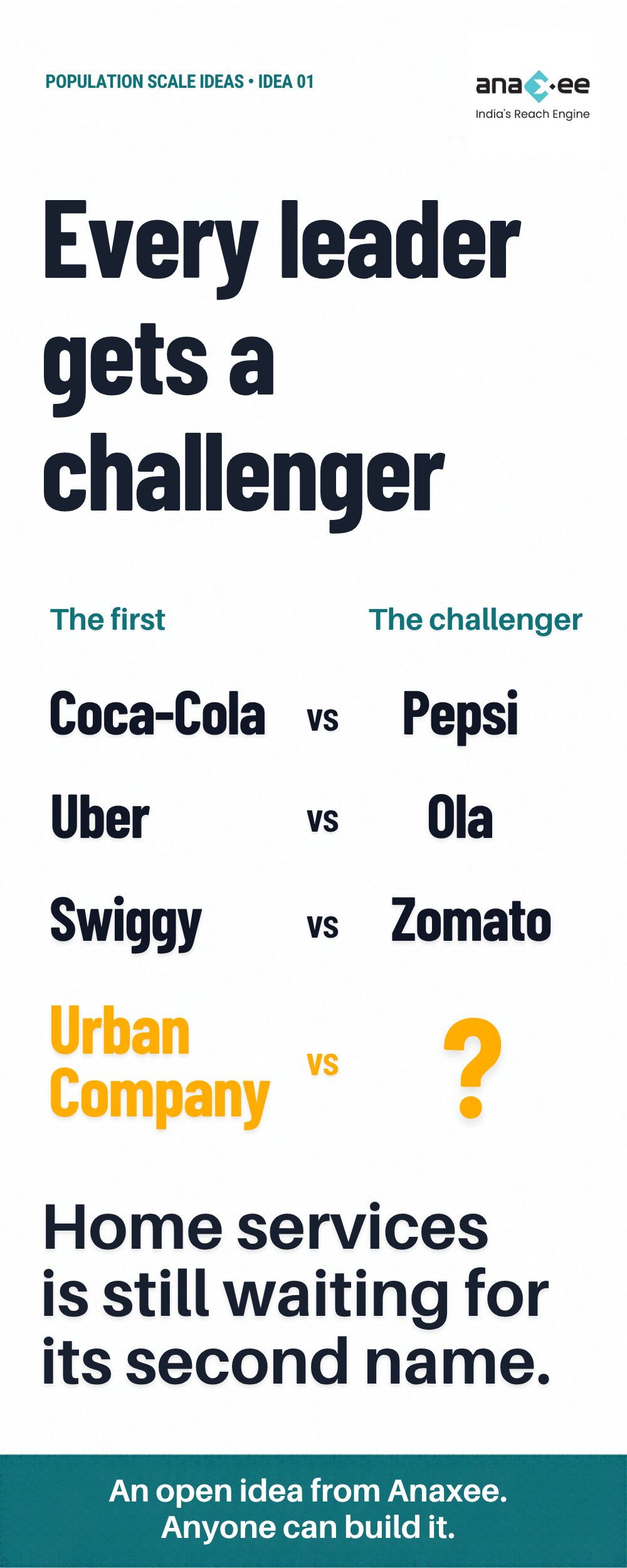
Coca-Cola has Pepsi. Uber has Ola. Swiggy has Zomato. No large consumer category in India has stayed with one company for long.
Home services is the exception. Eleven years after Urban Company began, we see no company of comparable size competing with it across the full range of services. The fight has not started.
A second player is not bad news for the first. It grows the habit, keeps prices honest for customers and gives professionals a choice of platform. And no market leader can run away from a fight forever.
This is not a small-town idea either. It is an all-India one: the same metros the leader serves, and the cities it has not reached yet.
The story so far
They paid for the lessons. The lessons are public.
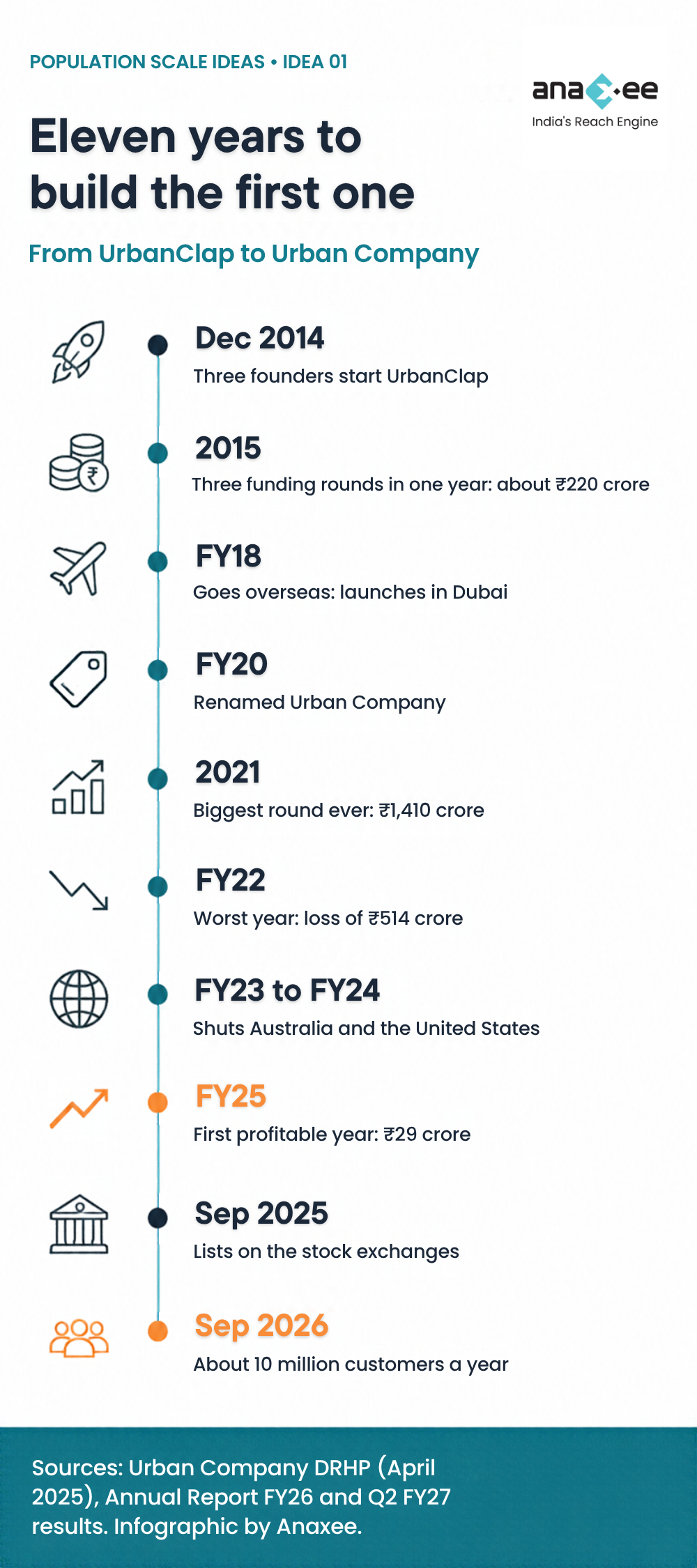
In December 2014 three founders registered a company called UrbanClap. Abhiraj Singh Bhal had studied at IIT Kanpur and IIM Ahmedabad and worked at BCG. Varun Khaitan came from IIT Kanpur, Qualcomm and BCG. Raghav Chandra came from UC Berkeley and Twitter. The problem they picked was an ordinary one: finding a plumber, an electrician or a beautician you could trust.
Within a year they had raised three rounds, about ₹220 crore. They went to Dubai in FY18, renamed the company Urban Company in FY20, and raised ₹1,410 crore in a single round in 2021. FY22 was the worst year, with a loss of ₹514 crore before tax. They shut Australia and the United States, made their first annual profit in FY25 and listed on the stock exchanges in September 2025.
None of this is criticism. They were building a habit that did not exist, and they were fortunate to have the money to keep learning. The second player does not have to pay for the same lessons. They are all in the filings.
The plan in eight chapters
One story, eight chapters. Start at 01.
Each chapter picks up where the last one stops: the market, the first mover, what it cost, what it learned, why now, the plan, the numbers and the ground work. Every chapter ends with a button to the next.
A ₹5 lakh crore market, barely online
India’s home-services market. Less than 1% of it is booked online today.
Three founders, one ordinary problem
micro-markets served, with 83% of booking value coming from repeat customers.
Not every rupee was productive
raised from investors before the IPO. Accumulated losses stood at ₹1,569 Cr in March 2026.
The core makes money. The experiments cost money.
cities between 2023 and 2026. Two countries exited. Every experiment is on the record.
The habit is built. The fight has not started.
of customer queries at Urban Company are now closed by AI, with no human involved.
47 cities. 24 months. Door to door.
Six months of preparation, then 47 cities in three waves.
A fifth of the money. Two years, not eleven.
of the capital the first mover raised. Roughly ₹463 Cr at the peak.
Built in apps. Won on the street.
A distributed human network plus technology, back office and quality checks. Where Anaxee fits.
How to read these numbers
Every Urban Company figure comes from its own public filings: annual reports, the draft red herring prospectus and quarterly results. The challenger plan is Anaxee’s estimate, with costs deliberately kept on the higher side. This series is an invitation to think big, not investment advice. Urban Company is not associated with it.
Quick answers
Questions people ask
Who are Urban Company’s competitors in India?
Most home services in India are still booked offline, through local agencies, neighbourhood contacts and independent professionals. A few newer apps focus on a single category, such as quick household help. By our reading of public information, no company of comparable size competes with Urban Company across the full range of services. That gap is what this page is about.
How much funding has Urban Company raised?
About ₹2,385 crore from investors between 2015 and 2022, before its IPO. We added this up from the share-allotment tables in its prospectus. It raised a further ₹472 crore of fresh capital when it listed in September 2025.
Is Urban Company profitable?
It made its first annual profit in FY25, ₹29 crore before tax. In FY26 it reported a loss of ₹175 crore before tax, mainly because of its new quick-help service. Its core India services business earned ₹131 crore at the operating level in FY26.
How much would it cost to build a company like Urban Company today?
Our draft estimate is about ₹463 crore of funding at the peak, over 24 months, to reach 47 cities. That is roughly one-fifth of what the first mover raised. Every cost is kept on the higher side, and the working is shown line by line.
Who founded Urban Company, and when?
Abhiraj Singh Bhal, Varun Khaitan and Raghav Chandra. The company was registered in December 2014 as UrbanClap and was renamed Urban Company in FY20.
How big is the home services market in India?
About ₹5 lakh crore a year, according to the industry research quoted in Urban Company’s filings. Less than 1% of it is booked online. See the market in detail.
Is this series connected to Urban Company?
No. Urban Company is not associated with it. Every figure about the company comes from its own public filings. The challenger plan is Anaxee’s estimate, and it is not investment advice.
What does Anaxee do, and why is it writing this?
Anaxee runs a network of 40,000+ Digital Runners across 540 districts in 26 states, with technology and AI checks behind them, for companies that need work done on the ground. Population Scale Ideas is our founder’s way of showing what such a network makes possible, whoever builds it.
Related on Anaxee: Feet on street outsourcing · Gig workforce vs manpower outsourcing · Go-to-market · Field coverage across India · Case studies
Who will build it
It needs the willingness of just one of them
Founders
The playbook is public and the habit already exists. What is needed is a team that can run operations in many cities at once.
Investors
By our draft estimate the challenger needs about ₹463 crore at its peak, against roughly ₹2,385 crore the first mover raised. Chapter 07 shows the working.
Corporates
A large company with a consumer brand, service staff or a dealer network already owns part of what a startup would have to build from zero.
Whether Anaxee is part of it or not, the idea is open. We are glad to advise.

Speak to Govind Agrawal
Founder and CEO of Anaxee. He wrote this series.
Have the will to build this one?
Founders, funds and corporates: bring the will and the budget. Govind Agrawal, founder and CEO of Anaxee, will walk you through the plan and share the full month-by-month working.
Book a call with GovindWhatsApp usCall +91 95841 32577Email sales@anaxee.com