BLOG
Gig Workforce vs Manpower Outsourcing: Which Field Model Wins?
 About Anaxee
40,000+ Digital Runners · 540 districts · 26 states · 11,000+ pincodes of reach
When you need people in the field, the first fork in the road is how you engage them: outsource a dedicated team to a staffing partner, or tap a gig workforce on demand. Both are forms of field manpower outsourcing, and both have a right time. The mistake is choosing on price alone and discovering, three months in, that the model never fit the work.
This guide compares the two honestly – what each is, where each wins, and how they stack up on the dimensions that actually matter.
The two models, defined
Manpower outsourcing
Full-time / contract staff
A staffing agency recruits, employs and compliance-manages field staff dedicated to you (PF, ESI, payroll). You direct them daily; they are a fixed team.
Feels like
Your own team, minus the HR and compliance load.
Gig field workforce
On-demand, task-based
A ready network of trained field people you deploy per task and per place, paid per completed job. Scale up for a project, down after.
Feels like
A tap you open and close as the work demands.
Managed gig (Anaxee)
Network + back office + tech
The gig network plus a partner that supervises, tech-tracks, trains, pays and quality-checks every task – flexibility with control.
Feels like
An outcome delivered, not a team you manage.
Head to head, on what matters
Why full-time outsourcing still makes sense
None of this means full-time manpower outsourcing is obsolete – for the right work it is the better answer. Choose it when the role is dedicated and ongoing (the same person doing the same job every day), when it sits in one or a few fixed locations, when deep institutional knowledge builds up over time, or when you specifically want statutory employment and compliance handled for a standing team. A fixed shop-floor crew, a city’s dedicated service technicians, a permanent help desk – these are full-time jobs, and outsourcing them to a staffing partner is sound.
Why a gig workforce wins for field work
But most field work is not that. It is a survey across 200 districts, a product launch that runs hot for three months, a seasonal verification drive, a one-time census, a merchant-onboarding push. The work is variable, spread out and time-boxed – exactly where a full-time team either sits idle or cannot reach. A gig field workforce was built for this shape of work: instant scale, national reach, pay-per-task economics, and – with the right tech – full visibility of what got done.
The real answer: a managed blend
In practice the best programmes are not purely one or the other. They run a gig network for the variable, spread-out work and keep a small dedicated core where it genuinely helps – all under one managed roof so the quality bar is the same everywhere. That is the Anaxee model: an on-demand network you scale freely, wrapped in the back office, technology and quality control that make it dependable. You get gig flexibility without surrendering control.
Not sure which model fits your field work?
Tell us the task, the geography and the pattern of demand, and we’ll tell you honestly whether gig, full-time or a blend fits – and scope it across 540 districts.
Where technology decides it
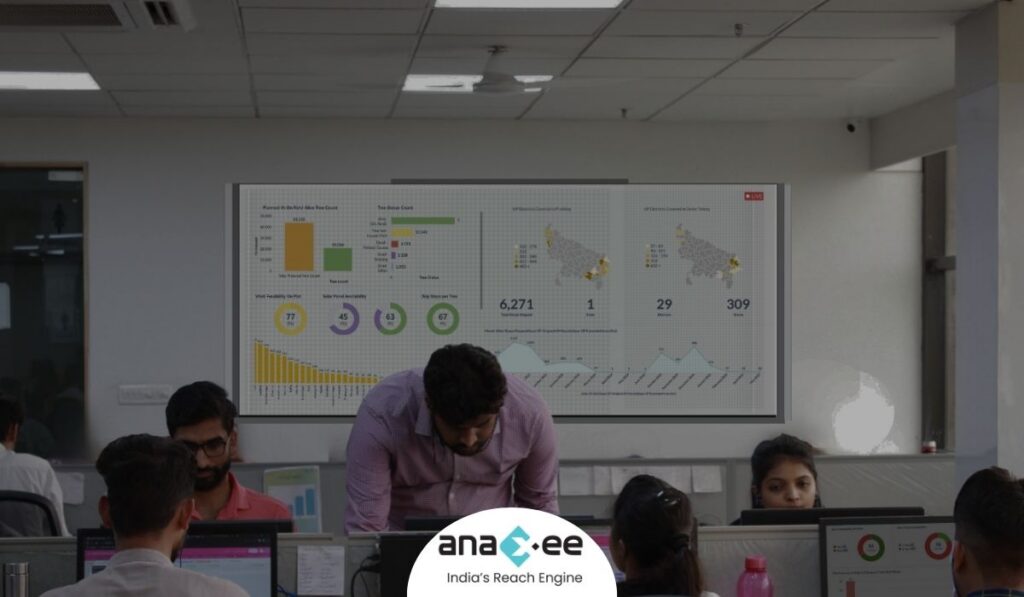
The entire case for a gig field workforce rests on one thing: can you see and trust the work? Technology is the answer. Every task runs on an app – geo-tag, timestamp, photos, the data itself – tied to a real person and place; AI flags the records that do not add up for re-verification; and it all lands on a live dashboard with API hooks into your systems. Without that layer, gig is a gamble. With it, gig beats a dispersed full-time team on both flexibility and accountability. That is why the model only works at scale when a technology company runs it.
How Anaxee helps
Anaxee – India’s Reach Engine, a National Startup Award winner – is the managed field-manpower-outsourcing layer: an on-demand network of 40,000+ Digital Runners across 540 districts, run with a back office, technology, training, payments and quality control, delivered on a live dashboard. Brands plug in for surveys, retail, go-to-market and agri field work – instead of hiring a team.
Proof – deployed, not hiredThousands of field people deployed on demand – no hiring, scaled to each programme. See all case studies →


What happens when you reach out to Anaxee
- Tell us the work – the task, the geography and the demand pattern – by form, WhatsApp or a call.
- A real person calls back – our Indore team, within one working day.
- We recommend the model – gig, full-time or blend – and scope a managed pilot on a dashboard you can open.
A 150+ person team in Indore and 40,000+ Digital Runners on the ground – honest advice on the model, then the field run for you.
Tell us about your field workforce need
Share the task, geography and demand pattern – our team will get back within one working day.
Frequently asked questions
What is the difference between gig workforce and manpower outsourcing?
Is a gig workforce cheaper than full-time outsourcing?
When should I choose full-time manpower outsourcing?
How do I keep quality with a gig workforce?
Can I combine both?
The bottom line
Gig versus full-time manpower outsourcing is not a contest with one winner – it is a fit decision. Steady, concentrated, ongoing work favours a dedicated outsourced team. Variable, spread-out, project-based field work favours a gig network. And the best of both is a managed blend: the flexibility of gig with the control of a run team. Match the model to the work, and the field stops being the part of the plan that breaks.
Talk to Anaxee – whichever way is easiest