Population Scale Ideas / Idea 01 / Chapter 04
Chapter 04 of 08 · What they learned the hard way
The Indian core makes money. The experiments cost money.
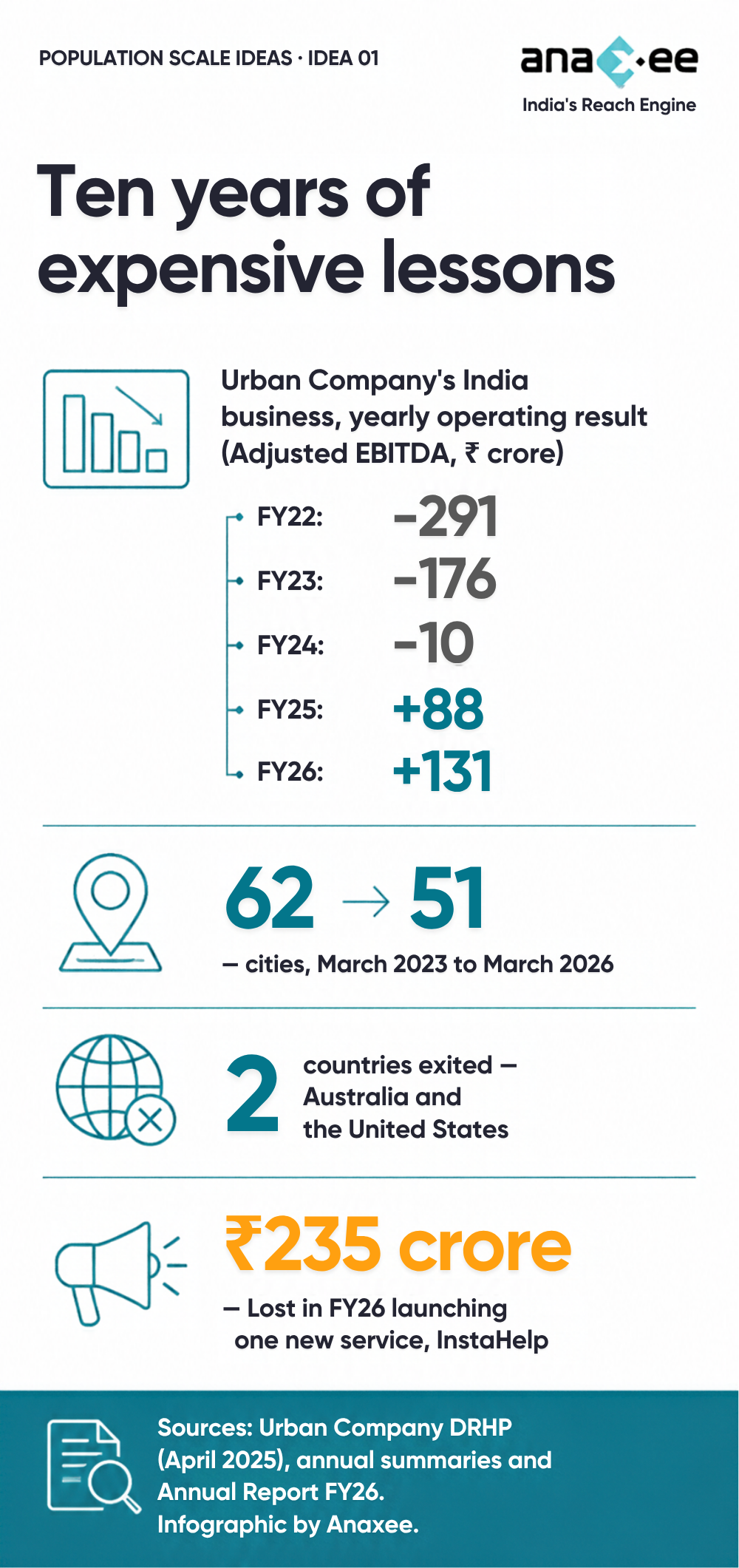
India’s core services business earned ₹131 crore at the operating level in FY26. Two countries were shut, and the newest service lost ₹235 crore in a single year. A listed company has to publish all of it. For a challenger, that is a free map.
Urban Company’s India business made an operating loss of ₹291 crore in FY22. The loss narrowed to ₹176 crore in FY23 and ₹10 crore in FY24. FY25 was the first profitable year, at ₹88 crore, and FY26 brought ₹131 crore. These are Adjusted EBITDA figures for the India services business, as the company reports them.
So the core business needed years of losses before it paid for itself. Along the way the company tried a great many things.
Markets it entered and left
In March 2023 the company was present in 62 cities across India and overseas. By March 2026 that was 51. It ceased operations in Australia in FY23 and in the United States in FY24, and moved its Saudi Arabia business into a joint venture from January 2025.
New bets cost real money
Native, its range of water purifiers and smart locks launched in October 2023, reached ₹345 crore of sales value in FY26 and was still loss-making.
InstaHelp, an on-demand house-help service, lost ₹235 crore in FY26, its first year. In the single quarter from July to September 2026 it lost another ₹174 crore while delivering 6.2 million orders.
Where the maths worked
Look at where the money was made, not only at where the flag was planted. The India business turned profitable in FY25. The overseas business, taken together, only reached break-even in FY26.
Inside India, Urban Company is present in 47 cities. It has tried well beyond the metros. Yet the top 8 cities still account for 85 to 90% of all online home-services spending in the country.
That is not the whole picture. By the company’s own estimate, about 65% of the market it can serve lies in the next 192 cities, and its bookings in smaller cities grew about 37% in the latest quarter, against 26% for the India business overall.
So a challenger should not think in terms of metros or small towns. It should read all of India as one map and decide, city by city, where the maths works.
Four lessons a challenger can take
Density beats footprint. The company now reports its business by micro-market, not by the number of cities on the map.
Habits pay. Most of the booking value comes from customers who return, so services people need again and again matter most.
Every new market is a fresh start. Even with a known brand, a new country or a new service began at a loss.
Patience is part of the cost. The India business took until FY25 to turn profitable. A plan that assumes profit in year one is not a plan.
Sources: Urban Company draft red herring prospectus, April 2025; FY23 annual summary; Annual Report FY26; Q2 FY27 shareholders’ letter, 16 October 2026. The four lessons are Anaxee’s reading of those filings. Urban Company is not associated with this series.
Chapter 04 of 08 done · keep going
Next, chapter 05: The habit is built. The playbook is public. The fight has not started. →

Speak to Govind Agrawal
Founder and CEO of Anaxee. He wrote this series, and the booking link goes to his calendar.
Want to build this, fund it, or argue with the numbers? Pick whichever way suits you.
Book a call with GovindWhatsApp usCall +91 95841 32577Email sales@anaxee.com
Related on Anaxee: Feet on street outsourcing · Gig workforce vs manpower outsourcing · Go-to-market · Field coverage across India · Case studies