Population Scale Ideas / Idea 01 / Chapter 03
Chapter 03 of 08 · What it cost
Not every rupee was productive. That is the point.
Going first is expensive. Urban Company raised about ₹2,385 crore before its IPO, and by March 2026 its accumulated losses stood at ₹1,569 crore. The second player gets the lessons without the bill.
Between 2015 and 2022, Urban Company raised about ₹2,385 crore from investors across its funding rounds. We added this up from the share-allotment tables in its prospectus: shares issued, multiplied by the price paid.
By March 2026 its accumulated losses stood at ₹1,569 crore. That is equal to roughly two-thirds of everything it raised before the IPO.
In September 2025 the company listed on the stock exchanges and raised a further ₹472 crore of fresh capital.
Where the money went
Professionals. Urban Company spent ₹111 crore, ₹149 crore and ₹137 crore in three successive years, FY22 to FY24, on bringing professionals onto the platform: training rooms, trainers, materials and referral payments. In FY24 it trained about 35,000 people. That works out to roughly ₹39,000 each.
Customers. Advertising cost ₹164 crore in FY25 and ₹230 crore in FY26.
Experiments. International markets, new product lines and new services all needed funding before they earned anything. Chapter 04 covers what came of them.
Not every rupee was productive. Some of it paid for mistakes, and for the lessons that came with them. The company was fortunate to have enough money to make those mistakes and still be standing.
Where the heavy spending sat
| Where | Period | ₹ crore |
|---|---|---|
| Advertising and marketing | FY22 to FY26 | 924 |
| Finding, training and onboarding professionals | FY22 to December 2024 | 513 |
| International business, operating losses (net) | FY22 to FY26 | 318 |
| InstaHelp, the new quick-help service, operating loss | FY26 alone | 235 |
| Native, its own product line, operating losses | FY23 to FY26 | 97 |
The first two lines are costs. The last three are operating losses (adjusted EBITDA) of those businesses. The lines overlap, so they do not add up to the total raised. Sources: Urban Company DRHP (April 2025) and Annual Report FY26.
Profit and loss before tax, year by year
| Year | ₹ crore |
|---|---|
| FY22 | Loss of 514 |
| FY23 | Loss of 312 |
| FY24 | Loss of 93 |
| FY25 | Profit of 29 |
| FY26 | Loss of 175 |
What a second mover does not pay for
Three things. Proving that Indians will book home services on an app. Teaching professionals to work through a platform. Finding out which cities and services pay.
The first mover has paid those bills. The receipts are in its filings for anyone to read.
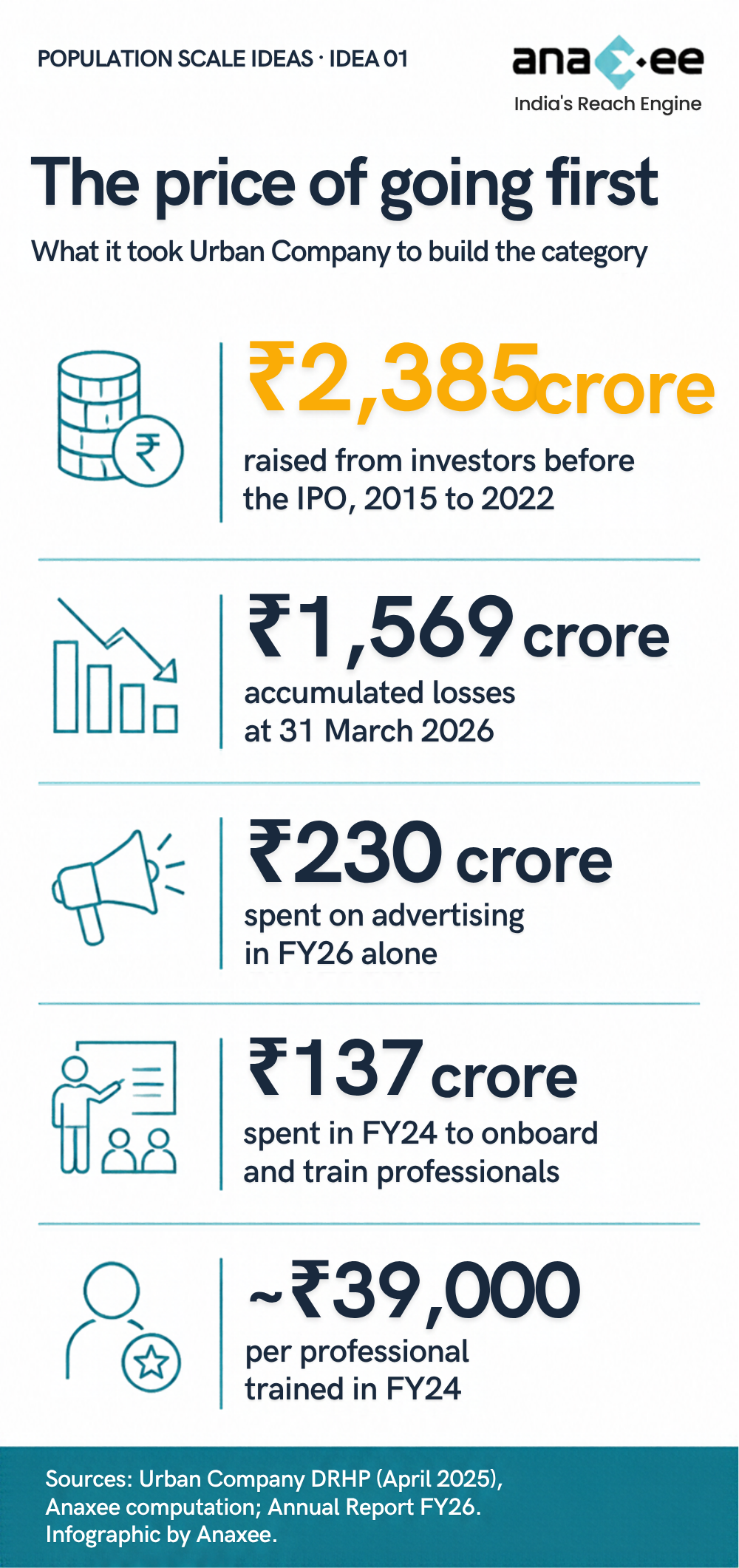
Sources: Urban Company draft red herring prospectus, April 2025 (share-allotment tables and service professional onboarding costs; totals are Anaxee’s computation); FY24 annual summary; Annual Report FY26. Urban Company is not associated with this series.

Speak to Govind Agrawal
Founder and CEO of Anaxee. He wrote this series, and the booking link goes to his calendar.
Want to build this, fund it, or argue with the numbers? Pick whichever way suits you.
Book a call with GovindWhatsApp usCall +91 95841 32577Email sales@anaxee.com
Related on Anaxee: Feet on street outsourcing · Gig workforce vs manpower outsourcing · Go-to-market · Field coverage across India · Case studies