
 About Anaxee
40,000+ Digital Runners · 540 districts · 26 states · 11,000+ pincodes of reach
For most students in India, the final year of engineering or MCA is both exciting and stressful. You are balancing exams, placements and one big milestone: the final year project.
On paper, the project showcases everything you have learned. In reality, many students end up doing recycled work — a face recognition system, a library management app, or a dataset downloaded from Kaggle. It ticks the academic requirement, but it rarely helps you stand out in an interview.
That is why choosing the right project matters. It can be a formality — or the stepping stone into your career.
What is applied AI?
Unlike pure research, applied AI takes theoretical concepts and implements them in real, practical environments. It is less about a new algorithm and more about understanding how AI fits into business, operations and real-world decision making — which is exactly the experience final year students are missing.
Why traditional college projects fall short
The outcome? Students graduate with a degree, but without the confidence to say, “I can solve real-world problems with technology.”
Build your final year project on real-world data.
The Applied AI Residency is open on a rolling basis. Create your profile, pick one of 9 problem statements and send a proposal.
Why real datasets make all the difference
Ask any recruiter in tech and they will tell you: working on real datasets separates average projects from impactful ones.
Scale
Instead of 500 rows, you deal with large volumes of voice calls, images, emails and survey records. Handling that scale builds true data engineering skills.
Messiness
Real data has noise, errors, missing values and inconsistencies. Preparing it is half the job — and the half most college projects skip.
Relevance
You solve problems that companies actually face, not theoretical case studies.
Portfolio power
When you show a recruiter that your model worked on real-life, messy data, you instantly stand out.
Where technology and AI change the game
Applied AI in a field operation looks like this: voice assistants that work in multiple Indian languages, computer vision models that check image quality in real time, automation of emails, CRM updates and WhatsApp-based task tracking, and validation of large volumes of field data collected from across the country.
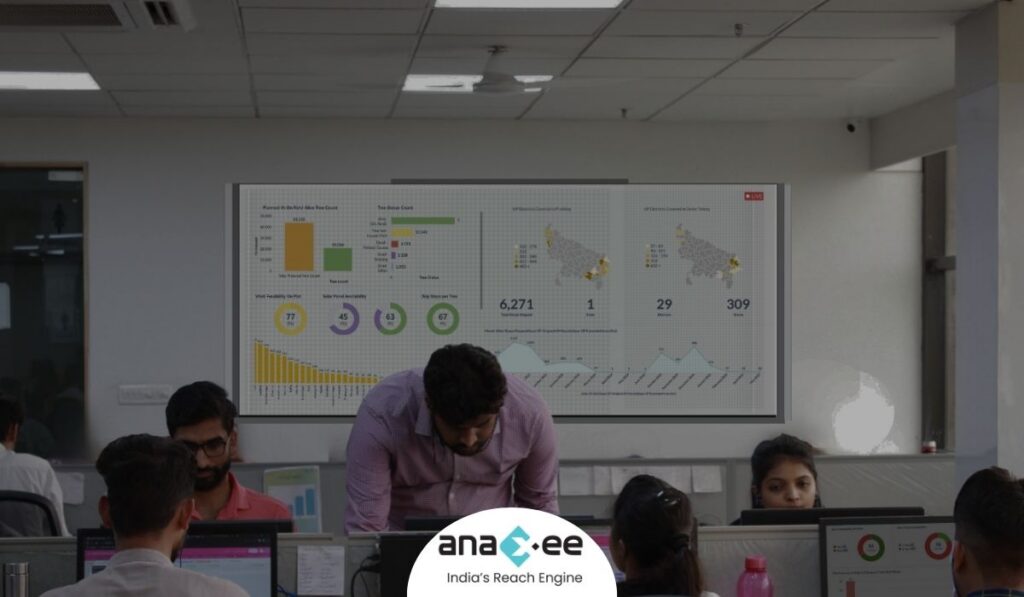
At Anaxee, every Digital Runner visit is captured in a field app, geo-tagged and time-stamped, and flows to a live dashboard. Residency projects plug into that pipeline, so you learn to preprocess messy data, build scalable models and deploy them — with exposure to NLP, computer vision, RAG pipelines and multilingual AI along the way.
How Anaxee helps
Anaxee — India’s Reach Engine, a National Startup Award winner working with 350+ brands — runs last-mile field work across 540 districts and 11,000+ pincodes from its base in Indore. The Applied AI Residency opens that work to students: datasets collected since 2016, projects designed around real business use cases, mentorship from industry experts, Anaxee’s founder and your faculty, and a live testing environment where your model runs inside Anaxee’s operations. Colleges looking for industry–academic collaboration on student projects can reach the team through the student help desk.
Real-world data projects you can pick9 projects in all, each drawn from an actual business need. See every project →
What happens when you apply
- Complete your profile — semester, degree, GitHub link and past experience.
- Choose a project and write a proposal — a detailed one of 500+ words on your approach, tech stack and timeline.
- Selection and onboarding — proposals are evaluated, you get an email at every status change, and selected students start on the data with mentor support.
A 130+ person team in Indore and 40,000+ Digital Runners on the ground — your project connects to real operations, not a sandbox.
Frequently asked questions
What is an applied AI final year project?
Can this count as my official final year project?
Who should apply?
What skills do I need before applying?
What kind of data will I work with?
Will my model actually be used?
Is the residency paid?
Is there a deadline?
How are proposals selected?
Can my college partner with Anaxee?
Why Anaxee?
The bottom line
When the recruiter asks “Tell me about your final year project”, you can say you built a basic chatbot on a small dataset you found online — or that you built a multilingual AI assistant on real user conversations, tested it in a live environment and were mentored by industry experts. The second answer makes you memorable and proves you are job-ready. Applied AI on real-world data is how you earn it.
40,000+ Digital Runners · 540 districts · 26 states · 11,000+ pincodes — ~60% of India
Reached ~3 million Indians during COVID and helped deliver ~2 million vaccinations — Project SwaRAKSHA, last-mile and country-scale.
Our founder, Govind Agrawal, holds a US patent. Govind Agrawal (CEO) · Arti Agrawal (COO) · Nilesh Maheshwari (CTO). Meet the founders →
Start your Applied AI Residency application