Applied AI Final Year Engineering Projects: Real-World Data Opportunities for Students in 2025

Quick answer: An applied AI final year project takes a real business problem, trains a model on real-world data and gets it working in a live setting — not just in a notebook. Anaxee’s Applied AI Residency gives final and pre-final year BE, BTech, ME, MTech and MCA students exactly that: real field data (images, audio calls, surveys and text), 9 live problem statements and a live environment to test in. Apply at students.anaxee.com.
AnaxeeAbout Anaxee

40,000+ Digital Runners · 540 districts · 26 states · 11,000+ pincodes of reach

★ Winner, National Startup Award (Govt. of India)Trusted by 350+ brands — incl. Mahindra & ITCIndia’s Reach Engine since 2016

For most students in India, the final year of engineering or MCA is both exciting and stressful. You are balancing exams, placements and one big milestone: the final year project.

On paper, the project showcases everything you have learned. In reality, many students end up doing recycled work — a face recognition system, a library management app, or a dataset downloaded from Kaggle. It ticks the academic requirement, but it rarely helps you stand out in an interview.

That is why choosing the right project matters. It can be a formality — or the stepping stone into your career.

The market reality
1 in 10
Only one qualified GenAI engineer is available for every ten open roles in India
1 qualified engineer per 10 open roles
Companies are short of engineers who can build working AI, not just describe it. A project on real-world data is the fastest way to prove you are one of them.
Source: TeamLease Digital, Digital Skills & Salary Primer 2025-26, via Zee Business

What is applied AI?

Unlike pure research, applied AI takes theoretical concepts and implements them in real, practical environments. It is less about a new algorithm and more about understanding how AI fits into business, operations and real-world decision making — which is exactly the experience final year students are missing.

Why traditional college projects fall short

  • Outdated problem statements. Projects that don’t match what the industry is working on today.
  • Limited datasets. A few hundred rows of CSV data or synthetic test cases.
  • No deployment. The project ends at “the code works” and is never tested in a real environment.
  • Copy-paste culture. Old code and ready-made solutions, reused year after year.

The outcome? Students graduate with a degree, but without the confidence to say, “I can solve real-world problems with technology.”

Where the data comes from
540 districts
of field operations feed the data residency students work with
26 states, 540 districts, 11,000+ pincodes26states540districts11,000+pincodes
Images, audio calls, surveys and text records collected by Anaxee’s Digital Runners since 2016 — data with all the noise, gaps and language variety of real India.

AnaxeeBuild your final year project on real-world data.

The Applied AI Residency is open on a rolling basis. Create your profile, pick one of 9 problem statements and send a proposal.

Start your applicationSee the 9 projects

Why real datasets make all the difference

Ask any recruiter in tech and they will tell you: working on real datasets separates average projects from impactful ones.

Scale

Instead of 500 rows, you deal with large volumes of voice calls, images, emails and survey records. Handling that scale builds true data engineering skills.

Messiness

Real data has noise, errors, missing values and inconsistencies. Preparing it is half the job — and the half most college projects skip.

Relevance

You solve problems that companies actually face, not theoretical case studies.

Portfolio power

When you show a recruiter that your model worked on real-life, messy data, you instantly stand out.

Fun fact: India Post introduced the six-digit PIN code on 15 August 1972. Half a century later, matching geo-tagged field records to the right pincode is still one of the messy, real-world data problems an applied AI project has to handle.

Where technology and AI change the game

Applied AI in a field operation looks like this: voice assistants that work in multiple Indian languages, computer vision models that check image quality in real time, automation of emails, CRM updates and WhatsApp-based task tracking, and validation of large volumes of field data collected from across the country.

At Anaxee, every Digital Runner visit is captured in a field app, geo-tagged and time-stamped, and flows to a live dashboard. Residency projects plug into that pipeline, so you learn to preprocess messy data, build scalable models and deploy them — with exposure to NLP, computer vision, RAG pipelines and multilingual AI along the way.

How Anaxee helps

Anaxee — India’s Reach Engine, a National Startup Award winner working with 350+ brands — runs last-mile field work across 540 districts and 11,000+ pincodes from its base in Indore. The Applied AI Residency opens that work to students: datasets collected since 2016, projects designed around real business use cases, mentorship from industry experts, Anaxee’s founder and your faculty, and a live testing environment where your model runs inside Anaxee’s operations. Colleges looking for industry–academic collaboration on student projects can reach the team through the student help desk.

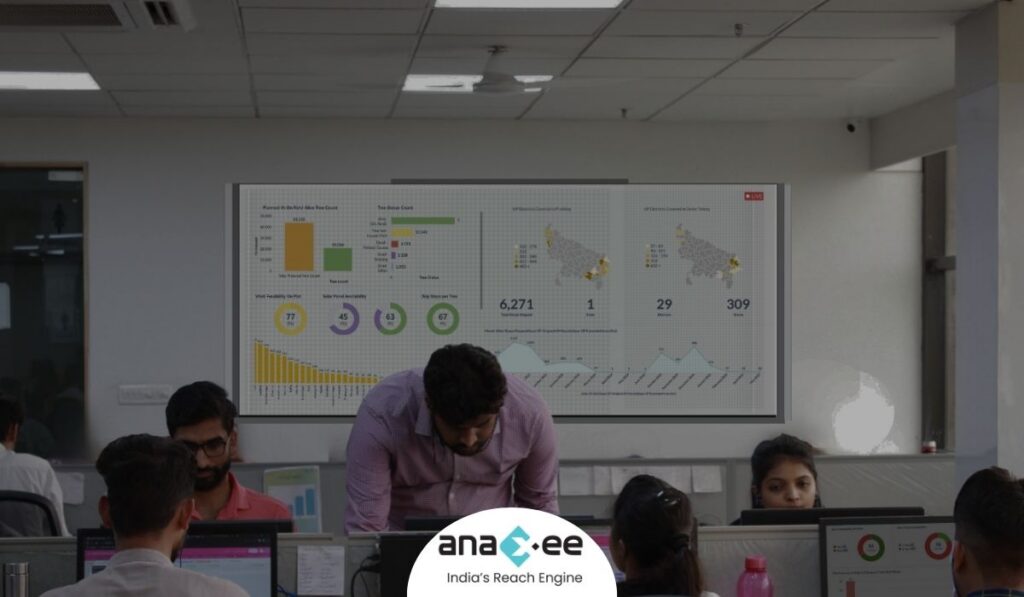
Anaxee team at work in the Indore office

AnaxeeWhat happens when you apply

  1. Complete your profile — semester, degree, GitHub link and past experience.
  2. Choose a project and write a proposal — a detailed one of 500+ words on your approach, tech stack and timeline.
  3. Selection and onboarding — proposals are evaluated, you get an email at every status change, and selected students start on the data with mentor support.

A 130+ person team in Indore and 40,000+ Digital Runners on the ground — your project connects to real operations, not a sandbox.

Frequently asked questions

What is an applied AI final year project?
A project that takes a real business problem, trains a model on real-world data and gets it working in a live setting, instead of stopping at a notebook or a slide deck.
Can this count as my official final year project?
Yes. The Applied AI Residency is designed to fit academic requirements.
Who should apply?
Students in the final or pre-final year of BE, BTech, ME, MTech or MCA who want a career in AI, ML or data science.
What skills do I need before applying?
Basic programming knowledge is enough. You learn the advanced skills during the residency, with mentor support.
What kind of data will I work with?
Data collected by Anaxee since 2016 from field operations across India — images, audio calls, surveys and text records — depending on the project you choose.
Will my model actually be used?
Projects are built around real Anaxee use cases and tested in a live environment inside Anaxee’s operations, so a model that works has a real place to run.
Is the residency paid?
No. It is not a paid internship. Its value is the data, the mentorship and the portfolio you leave with.
Is there a deadline?
No. Applications are open on a rolling basis at students.anaxee.com.
How are proposals selected?
The Anaxee team evaluates each proposal on your approach, tech stack and timeline. You get an email at every status change, and your portal dashboard shows where you stand.
Can my college partner with Anaxee?
Yes, the residency welcomes industry–academic collaboration on project execution. Reach the team through the student help desk.
Why Anaxee?
Few programmes give students this level of access to live Indian field data and a real-world testing environment for their own model.

The bottom line

When the recruiter asks “Tell me about your final year project”, you can say you built a basic chatbot on a small dataset you found online — or that you built a multilingual AI assistant on real user conversations, tested it in a live environment and were mentored by industry experts. The second answer makes you memorable and proves you are job-ready. Applied AI on real-world data is how you earn it.


★ Winner, National Startup Award (Govt. of India)Trusted by 350+ brands

40,000+ Digital Runners · 540 districts · 26 states · 11,000+ pincodes — ~60% of India

Reached ~3 million Indians during COVID and helped deliver ~2 million vaccinations — Project SwaRAKSHA, last-mile and country-scale.

Our founder, Govind Agrawal, holds a US patent. Govind Agrawal (CEO) · Arti Agrawal (COO) · Nilesh Maheshwari (CTO). Meet the founders →

AnaxeeStart your Applied AI Residency application

Apply nowSee the projectsAsk a questionEmail

Final Year AI Project Opportunities: Build Your Career with Anaxee’s Applied AI Residency

Quick answer: Anaxee’s Applied AI Residency turns your final year project into real applied AI work. You pick one of 9 live problem statements, build on real field data from Anaxee’s operations, and get mentored by Anaxee’s tech team alongside your faculty. It is unpaid, open on a rolling basis to final year BTech, MTech, MCA and related students, and you apply at students.anaxee.com.
AnaxeeAbout Anaxee

40,000+ Digital Runners · 540 districts · 26 states · 11,000+ pincodes of reach

★ Winner, National Startup Award (Govt. of India)Trusted by 350+ brands — incl. Mahindra & ITCIndia’s Reach Engine since 2016

In your final year of engineering, MCA or M.Tech, one word follows you everywhere: project. It is the most visible proof of what you learned in three or four years, and it is usually the first thing an interviewer asks about.

The trouble is that most final year projects are outdated and disconnected from the real world. Students clone an old repository from GitHub, or build yet another face recognition system on a few hundred images. The project ticks the academic box, then sits in a PPT. When a recruiter says “Tell me about your final year project”, they are checking whether you did something for grades or actually solved a problem.

The Applied AI Residency exists to close that gap: real industry problems, real datasets and real mentorship, inside a company that runs field operations across India every day.

The market reality
~2x
India’s demand for AI talent is projected to roughly double by 2027
AI talent demand: 6 to 6.5 lakh vs 12.5 lakh plus6–6.5 lakh12.5 lakh+ (2027)
Demand is growing faster than the supply of job-ready engineers. The graduates who stand out are the ones who have already trained a model on real, messy data.
Source: Deloitte–Nasscom, Advancing India’s AI Skills, via Business Standard

What is the Applied AI Residency?

The Applied AI Residency is Anaxee’s programme for final year students who want their project to be more than an academic formality. Instead of a toy problem, you take on one of Anaxee’s own AI problem statements, work on real data from live projects across India, and have your model tested inside Anaxee’s operations. It is not a paid internship. It is a structured project that fits your academic requirements and leaves you with a portfolio recruiters take seriously.

Why final year students should apply

  • A resume line that means something. Compare “Chatbot using Python” with “Built an AI voice assistant tested on real user queries in multiple Indian languages.” Recruiters know which one is real work.
  • Data you can’t get elsewhere. Anaxee has collected images, calls, surveys and GPS inputs from across India since 2016 — the kind of data that teaches you more than any clean public dataset.
  • The skills companies pay for. Data preprocessing, model deployment, scaling and handling edge cases — learned on a problem someone actually owns.
  • Mentorship, not guesswork. Guidance from Anaxee’s CEO, its internal tech team and industry experts, alongside your own college faculty.
  • An early push into your career. Even before your first AI role, a portfolio of applied work shows employers you can think independently and solve real problems.
What you can work on
9
live AI problem statements, each tied to a real Anaxee use case
9 live AI projects
Voice AI in Indian languages, automatic rejection of bad field data, WhatsApp task bots, email and CRM automation, lead matching, an AI interviewer and a decision assistant.

Every one of these is a problem Anaxee’s own teams face. That is the difference from a hypothetical project: if your model works, someone will use it.

AnaxeeMake your final year project count — apply to the Applied AI Residency.

Open on a rolling basis, with no last date. Create your profile, pick a project and send a short proposal.

Start your applicationSee the 9 projects

What a good final year AI project looks like

It runs on real data

Small or synthetic datasets — 500 images of cats and dogs — hide every hard problem. Real field data is noisy, multilingual and incomplete, and learning to handle that is the actual skill.

It is deployed, not presented

Most academic projects end as slides. A good one ends as something that runs: a model inside an app, a CRM or a WhatsApp bot, tested on real inputs.

It solves a problem someone owns

Copy-paste projects from seniors teach very little. A project with a real owner forces you to define success, handle edge cases and defend your choices — exactly what interviews test.

Fun fact: India’s Constitution lists 22 scheduled languages. That is why a voice assistant for field workers in India has to be multilingual from day one — and why it makes such a hard, interesting final year project.

Where technology and AI change the game

Anaxee runs its field work as a tech product. Every visit by a Digital Runner is captured in a field app, geo-tagged and time-stamped, with photos, survey answers and call records flowing to a live dashboard. That pipeline is where your residency project lives.

The skills you build are the ones companies test for AI/ML, data science and product roles: NLP and speech recognition for voice bots and multilingual assistants, computer vision to validate images captured in the field, data engineering to clean and structure large datasets, model deployment into apps, CRMs and WhatsApp bots, and responsible AI — handling sensitive data and privacy properly.

How Anaxee helps

Anaxee — India’s Reach Engine, a National Startup Award winner working with 350+ brands — runs last-mile field work across 540 districts and 11,000+ pincodes, in climate, CSR and rural outreach as well as go-to-market. The residency gives students a seat inside that work: the problem statements, the data, the mentors and a live environment to test in. See every student programme, internship and job on Anaxee for Students, and read the student FAQ.

Anaxee team at work in the Indore office

AnaxeeWhat happens when you apply

  1. Create your profile — college, semester, degree, past projects and GitHub or portfolio links.
  2. Pick a project and send a proposal — a short one first, then a detailed one of 500+ words on your tech stack, method and expected output.
  3. Get reviewed — the Anaxee team reviews it, and you get an email at every status change, tracked on your dashboard.

A 130+ person team in Indore and 40,000+ Digital Runners on the ground — your project connects to real operations, not a sandbox.

Frequently asked questions

What is Anaxee’s Applied AI Residency?
A final year project programme where students work on one of Anaxee’s 9 live AI problem statements, using real field data and mentorship from Anaxee’s tech team and their own faculty.
Is this a paid opportunity?
No. It is not paid. It is designed to add more long-term career value than a short stipend would.
Who can apply?
Final year students from BTech, MTech, MCA and related programmes. MBA students can look at the Management Residency, and students drawn to social impact and climate at the Social Residency.
Is there a last date to apply?
No. Applications are open on a rolling basis. Apply when you are ready at students.anaxee.com.
Can this replace my college project?
Yes. The residency is designed as a formal project opportunity that fits your academic requirements.
How much time do I need to commit?
It runs alongside your academic timeline as your final year project. Most students dedicate 8–12 hours a week.
Do I need to be an AI expert to apply?
No. Basic programming skills are enough. You learn the AI concepts as you work through the problem with mentorship.
What do I submit when I apply?
A complete profile, then a proposal for the project you choose: a short version first, then a detailed proposal of at least 500 words covering your tech stack, methodology and expected output.
How will I know where my application stands?
You get an email at every status change, and your dashboard on the student portal shows where your application is.
What kind of AI projects can I work on?
Conversational and voice AI, AI for data quality, productivity AI for email, CRM and WhatsApp, decision intelligence and recruitment AI. Read all 9 on the project list.
Will this help me get a job?
Direct placement is not promised. But applied projects in your portfolio are a real advantage in interviews and campus placements, and strong residents may be considered for roles at Anaxee itself. See internships and jobs.
Who do I ask if I have a question?
Use the student help desk and the team will get back to you.

The bottom line

Your final year project can be a formality, or it can be the start of your career. If you are serious about building a future in AI, the Applied AI Residency gives you real data, a real problem and real mentorship — and a project you can talk about with confidence in every interview.


★ Winner, National Startup Award (Govt. of India)Trusted by 350+ brands

40,000+ Digital Runners · 540 districts · 26 states · 11,000+ pincodes — ~60% of India

Reached ~3 million Indians during COVID and helped deliver ~2 million vaccinations — Project SwaRAKSHA, last-mile and country-scale.

Our founder, Govind Agrawal, holds a US patent. Govind Agrawal (CEO) · Arti Agrawal (COO) · Nilesh Maheshwari (CTO). Meet the founders →

AnaxeeStart your Applied AI Residency application
Apply nowSee the projectsAsk a questionEmail