Booth-Level Voter Survey & Door-to-Door Field Data in India

The short version: In an Indian election the real unit is not the constituency — it is the polling booth, and the voter-list page under it. A booth-level voter survey is door-to-door field work organised at that smallest unit: trained local surveyors covering households directly, capturing the issues and mood booth by booth, and checking whether the campaign’s own organisation actually exists on the ground. It is the most useful and the most faked kind of political field work, because at the booth level there is nowhere for a made-up number to hide — if you insist on verification. This piece explains how booth-level and door-to-door surveys work, and what makes one trustworthy.

Every seasoned campaigner in India knows the saying: elections are won booth by booth. A constituency average can hide everything that matters — a seat that looks comfortable on the whole can be quietly bleeding in forty specific booths. The only way to see that is to go down to the booth itself, and often to the individual page of the voter list, and find out what is actually happening there. That is what a booth-level voter survey does.

Here is how door-to-door, booth-level field work is actually done — and how to make sure the data coming back is real.

What booth-level field work covers

  • Door-to-door contact. Trained local surveyors reach households directly, in the local language, booth by booth — the only way to hear what a community actually thinks.
  • Booth and page-level organisation. Work structured down to the polling booth and the voter-list page, so coverage is systematic rather than wherever happens to be convenient.
  • Issue and mood capture. What this booth cares about and how it is leaning — recorded as aggregate sentiment, not as a dossier on named individuals.
  • Ground-game reality checks. Does the booth committee on paper exist in the field? Are the local workers real and active? This is often the single most valuable thing a booth survey reveals.

Why the booth beats the constituency average

Averages lie by smoothing. A constituency can read “safe” while a cluster of booths inside it has turned — and if you only ever see the average, you will never move resources to the booths that could cost you the seat. Booth-level data is what makes surgical action possible: instead of spreading effort evenly across the whole constituency out of ignorance, a campaign can put its scarce days and workers exactly where the ground says it matters. You cannot do that from a constituency-wide number. You can only do it when the data goes down to the booth.

Verified booth data vs the kind that gets faked

The booth level is where fabrication is easiest to commit and easiest to catch. Easiest to commit, because nobody at headquarters can personally visit 300 booths to check. Easiest to catch, because real door-to-door work leaves a trail — a GPS point, a timestamp, a photo — and fake work does not. The whole value of a booth survey rests on insisting on that trail.

Trustworthy booth-level data The kind to distrust
Door-to-door visits by independent trained surveyors Forms filled in by the same booth workers being assessed
Every entry GPS-tagged and time-stamped at the booth No record of where or when the data was collected
Systematic coverage across all booths, including the hard ones Only the easy, nearby or friendly booths covered
Auditable live on a dashboard, booth by booth A single summary sheet with no way to drill down
Aggregate sentiment, collected with consent Covert dossiers on named individuals
The quickest way to judge a booth report: pick the three farthest, least convenient booths in the seat and ask to see the geo-tagged proof that someone actually went there. Faked surveys are always strongest in the booths nearest the surveyor’s tea shop.

Where Anaxee fits

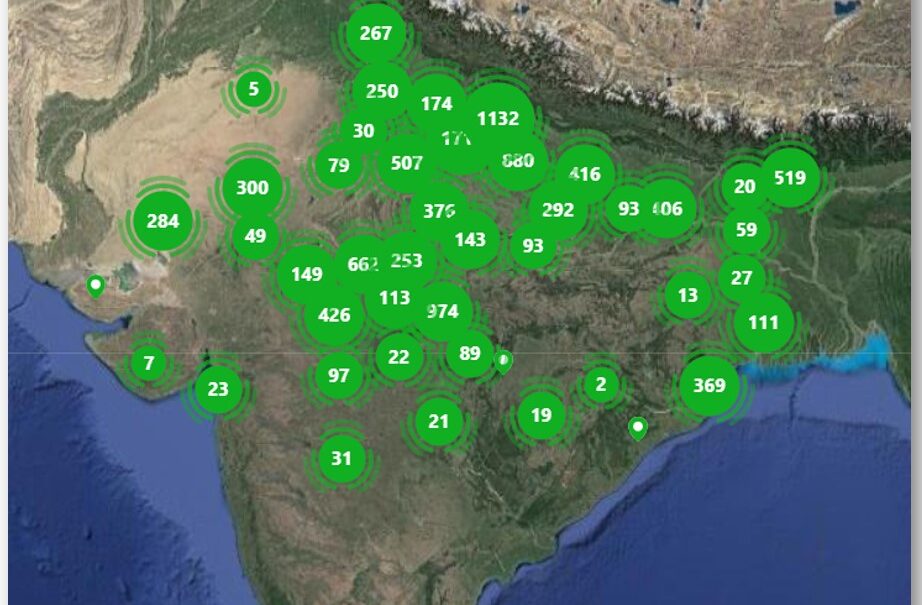
Anaxee runs the booth-level field work, not the politics. Its tech-enabled network of on-ground “Digital Runners” across 540 districts and 11,000+ pincodes can be organised down to the booth and the voter-list page, with trained local people — sons and daughters of the soil with confirmed local presence — doing credible door-to-door contact, and every activity GPS-tagged and visible live on a central dashboard. It is deliberately the execution-and-verification layer: Anaxee collects and verifies the ground data, on a strictly non-partisan basis for campaigns and civic bodies across the spectrum. It does not profile individual voters, predict results, endorse any party, or run campaign strategy — the aggregate, consented, verifiable ground truth is the product.

Need booth-level or door-to-door field work you can verify? We organise door-to-door surveys and outreach down to the booth and voter-list page, anywhere in India — GPS-tagged and auditable on a dashboard.

Election & civic field servicesTalk to us

Frequently asked questions

What is a booth-level voter survey?
It is door-to-door field research organised down to the individual polling booth (and often the voter-list page), capturing the issues and mood of each booth and checking whether the campaign’s local organisation is real. It records aggregate sentiment booth by booth, not profiles of named individuals.
Why is booth-level data better than a constituency average?
Because averages hide local problems. A seat can look safe overall while specific booths have turned against you. Booth-level data lets a campaign direct scarce time and workers precisely to the booths that need them, instead of spreading effort evenly out of ignorance.
How do you know door-to-door survey data is genuine?
Insist on a verification trail. Real door-to-door work produces a GPS tag, a timestamp and often a photo for each entry, auditable booth by booth on a dashboard. Fabricated work has no such trail and tends to cover only the easy, nearby booths. Check the hardest booths first.
Is booth-level outreach legal and ethical?
Legitimate booth-level field work is aggregate, consent-based research and professionally managed outreach — a normal part of democratic campaigning. It becomes a problem only when it drifts into covert profiling of individuals or manipulation. A credible provider stays on the aggregate, consented, non-partisan side of that line.
Does Anaxee do booth-level surveys?
Yes — as the neutral field-data layer. Anaxee organises door-to-door, booth and page-level surveys and outreach across 540 districts in India, GPS-tagged and dashboard-verified, on a strictly non-partisan basis. It supplies the verified ground data and does not predict results, profile individuals, or provide political strategy.
About this piece. General explainer on booth-level and door-to-door voter surveys, offered as perspective, not political or legal advice. Anaxee Digital Runners is an independent field-data and verification company; its election work is professional, aggregate, consent-based field execution on a non-partisan basis, and it does not provide voter profiling, polling predictions, political strategy, or campaign management.

Constituency Survey in India: How Field-Level Voter Research Works

The short version: A constituency survey is structured, on-the-ground research that tells a campaign what the people of one seat actually care about — the local issues, the awareness of each candidate, the mood block by block. Done well, it is honest field listening at scale. Done badly, it is a few phone calls dressed up as a sample, and it has lost more campaigns than it has won. The thing that separates the two is not the analysis — it is whether the field data underneath is real, representative and verifiable. This piece explains how a proper constituency survey works, and how to tell a trustworthy one from a fabricated one.

Before a serious campaign spends a rupee on hoardings or a day of the candidate’s time, it wants an answer to one question: what do the people of this constituency actually want, and where do we stand with them right now? A constituency survey is how that question gets answered with evidence instead of the local leader’s gut feeling. It is one of the most useful — and most often faked — tools in Indian electoral politics.

This is a practical guide to what a constituency survey really is, what it should measure, and the single thing that decides whether it is worth acting on: the quality of the field work underneath it.

What a constituency survey actually measures

A good constituency survey is not a crystal ball and it is not a list of names. It is an aggregated, representative read of a seat across a few concrete dimensions:

  • Local issues, ranked. What people in this constituency actually want fixed — water, roads, jobs, a specific grievance — and how that changes from one area to the next.
  • Awareness and recall. How well known each candidate and party is, and what people associate with them — the raw material of positioning.
  • Mood and leaning, by area. The overall sentiment across the seat and, crucially, how it varies block by block — which areas are strong, which are soft, which are already decided.
  • Reality checks on the ground game. Whether the booth committees and local workers that exist on paper actually exist in the field — often the most valuable finding of all.

Notice what is not on that list: a prediction of the final vote share, or a profile of individual named voters. A survey that promises to call the result to the decimal is selling confidence, not information; and research that drifts into profiling individuals by name crosses from legitimate aggregate study into something a credible, consent-based operation stays well clear of.

The real question: is the field data true?

Here is the uncomfortable open secret of political research in India. The analysis — the charts, the swing models, the colour-coded maps — is the easy part, and it looks identical whether the numbers under it are real or invented. The hard, expensive, decisive part is getting honest data out of the field in the first place: actually knocking on a representative spread of doors across the whole constituency, in every kind of area, and recording what people really said.

That is exactly the step that gets quietly skipped. A “constituency survey” can be a dozen phone calls to known supporters, a form filled in by the same party workers whose booths are being judged, or samples clustered in the two areas the surveyor could reach by lunch. The output looks like a survey. It is fiction with a chart on top — and a campaign that plans around it is planning around a flattering lie.

A survey worth acting on A survey to walk away from
Representative sample spread across the whole seat, every area type Samples clustered where the surveyor could easily reach
Door-to-door field work by independent, trained local surveyors Phone calls to existing supporters, or forms filled by party workers
Each response geo-tagged, time-stamped and verifiable after the fact No proof of where or when any interview actually happened
Independent of the people being measured Collected by the same workers whose performance it judges
Honest about what it cannot say (it reads the mood, it does not predict) Promises a precise final result
A simple test for any constituency report you are handed: ask to see where the interviews physically happened. If the answer is a map of geo-tagged points spread across the seat, it is probably real. If the answer is a shrug, you are looking at the ladder’s opinion of the constituency, not the constituency.

Why ground listening beats armchair prediction

India’s most respected campaign strategists keep repeating a point that cuts against the Silicon-Valley myth of the all-knowing algorithm: elections are won by exhaustive ground listening, not by remote number-crunching. The value of a constituency survey is not that it predicts the winner — it is that it tells a campaign, early and honestly, where it is weak, which issues are live, and where its own organisation is hollow, while there is still time to act. That is only possible if the listening actually happened on the ground. The model is downstream of the fieldwork, always.

Where Anaxee fits

Anaxee is the neutral field-data layer under a constituency survey — not the pollster who predicts, and not the strategist who runs the politics. Its tech-enabled network of on-ground “Digital Runners” spans 540 districts and 11,000+ pincodes, organised down to the booth and voter-list page, and it exists to do the one hard thing: collect a representative, geo-tagged, independently-gathered read of a constituency that a decision-maker can actually trust. Runners are local — sons and daughters of the soil with confirmed local presence — so the contact is credible, not parachuted in, and every interview is logged and auditable on a live dashboard. The work is strictly professional and non-partisan: Anaxee supplies verified ground data to campaigns and civic bodies across the spectrum; it does not endorse parties, predict results, or run strategy.

Planning a constituency survey and want field data you can actually trust? We run representative, geo-tagged, independently-collected ground surveys across any seat in India — booth by booth, verified on a dashboard.

Election & civic field servicesTalk to us

Frequently asked questions

What is a constituency survey?
It is structured field research in a single electoral constituency that measures what local people care about, how aware they are of each candidate, and the overall mood across the seat — aggregated and representative, not a profile of named individuals. It is used to plan a campaign on evidence rather than instinct.
How is a constituency survey conducted properly?
With a representative sample spread across every part of the constituency, collected door-to-door by independent trained surveyors, with each response geo-tagged, time-stamped and verifiable afterwards. The sample must not be clustered in easy-to-reach areas or filled in by the party workers whose own performance is being measured.
How can you tell a real survey from a fabricated one?
Ask for proof of where the interviews physically happened. A trustworthy survey can show geo-tagged interview points spread across the whole seat and is collected independently of the people being judged. A weak one clusters its sample, relies on phone calls to known supporters, or has no record of where the data came from.
Does a constituency survey predict the winner?
A good one does not claim to. Its value is in reading the mood, ranking the real local issues, and exposing where a campaign is weak or where its organisation is hollow — early enough to act. Precise final-result predictions are a separate, far less reliable exercise; the useful output is honest ground intelligence, not a forecast.
Does Anaxee run political surveys?
Anaxee provides the neutral field-data collection layer — representative, geo-tagged, independently-gathered constituency and booth-level surveys across 540 districts in India, on a strictly non-partisan basis. It supplies verified ground data; it does not predict results, offer political strategy, or endorse any party or candidate.
About this piece. General explainer on how constituency surveys work, offered as perspective, not political or legal advice. Anaxee Digital Runners is an independent field-data and verification company; its election work is professional field execution on a non-partisan basis, and it does not provide polling predictions, political strategy, or campaign management.

Data-Driven Election Campaigns: How Campaigns Hear the Ground

The short version: A candidate cannot knock on ten million doors. A campaign runs on a simple, hard question: what do the people we are trying to represent actually care about, and where? Good field data is how a campaign hears the ground instead of guessing at it — mapping the real issues booth by booth, putting scarce time and volunteers where they matter, and checking whether the message is landing. Used openly, this is just listening at scale. Used in the dark, it becomes manipulation — which is exactly why how the data is gathered matters as much as the data. This is part of a series on how ground-truth data closes the distance between decision-makers and reality.

Every election is, underneath the noise, a distance problem. A candidate is asking to represent hundreds of thousands — sometimes tens of millions — of people they will never personally meet. The old way of bridging that distance was instinct: the seasoned local leader who “knew the mood.” Sometimes they were right. Often they were telling the high command what it wanted to hear. Data-driven campaigning is the attempt to replace that single filtered opinion with something closer to what people on the ground are actually saying.

This is a neutral capability, like a telephone or a printing press. It is used by campaigns across the political spectrum, in India and around the world. Here is what it actually does, the real cases that made it famous, and the honest line between listening and manipulation.

What data actually does for a campaign

The popular image — shadowy consultants “micro-targeting” voters — is the smallest and most controversial part of the job. The larger, more mundane reality is four things:

  • Issue mapping. What do people in this block actually want fixed — water, roads, jobs, a specific grievance? Field surveys turn a vague “the mood is anti-incumbent” into a concrete, local list.
  • Resource allocation. A campaign has limited days, money and volunteers. Data tells it which booths are genuinely in play and which are already decided, so effort goes where it can change the outcome — a surgical use of scarce resources.
  • A feedback loop. Is the candidate’s message actually landing, or only landing in the echo chamber? Repeated ground readings tell a campaign whether to adjust — before election day, not after.
  • Operational truth. Are the booth committees real or on paper? Did the rally actually draw a crowd? Independent field verification stops a campaign from believing its own optimistic reports.

Three cases that defined the playbook

Campaign What they did The lesson
Obama 2012 (USA) Built a large in-house analytics team that modelled the electorate person by person and tested messages relentlessly — the operation journalists nicknamed “the Cave.” Showed that disciplined data and experimentation, not just advertising spend, could drive turnout and targeting.
Indian booth-level data operations Major Indian parties built booth-level databases and volunteer apps to track issues, workers and turnout at the most granular unit of the Indian electoral system. Proved the same logic works at India’s scale — the booth, not the constituency, is the real unit of a ground campaign.
Professional poll strategists (e.g. IPAC) India’s best-known campaign strategists built their reputation on large-scale ground listening — door-to-door surveys and feedback — over pure number-crunching. Their own repeated message: ground listening beats armchair analytics. Data guides, but the signal has to come from real people.

These are documented public cases, described here to explain the method — not an endorsement of any party, candidate or consultant. The common thread is not ideology. It is that each one tried to replace a guess about the voter with a measurement of the voter.

The quiet irony of political data: the campaigns that win with it are usually not the ones with the cleverest algorithm, but the ones most willing to hear bad news from the ground — that their star candidate is unpopular in a stronghold, that the “sure” booth is slipping. Data only helps a campaign that is willing to be told it is wrong.

The dark side — and the honest line

No piece on this topic is complete without Cambridge Analytica, the firm that harvested Facebook data without consent to build psychological profiles for political targeting. It is the cautionary tale for good reason: the same techniques that let a campaign listen can, without consent and transparency, be used to manipulate. The problem there was never “data.” It was data taken without permission and used in the dark.

The honest line is consent and transparency. Field data gathered openly — people knowingly answering a surveyor, aggregated to understand what a community wants — is democratic listening. Data scraped covertly to psychologically target individuals is not. A healthy democracy does not ban the telephone because of the scam call; it insists the call be honest about who is calling and why.

Where an independent field layer fits

Most of what a serious campaign needs from data is not exotic modelling. It is trustworthy, verifiable ground information at scale: honest issue surveys, booth-level reality checks, and verification that the organisation on paper exists on the ground. That is a last-mile data-collection problem — the same one that shows up in governance and business.

Anaxee operates as a neutral field-data and verification layer: a tech-enabled network of on-ground “Digital Runners” across 540 districts and 11,000+ pincodes in India that can collect geo-tagged, time-stamped survey and verification data, and feed it into a dashboard a decision-maker can actually read. The posture is deliberately simple — it is the layer that collects and verifies ground data; it does not run the campaign, take sides, or sit in the strategist’s chair. The data is the product; the decisions belong to the people accountable for them.

Need verified ground data at scale — issue surveys, field checks, independent verification across districts? That neutral collection-and-verification layer is what we do.

See our field coverage

Frequently asked questions

How do political campaigns use data to win elections?
Mainly to listen and allocate: mapping which issues matter in which areas, deciding where scarce time and volunteers will change the outcome, checking whether the message is landing, and verifying that ground operations are real. The headline-grabbing “micro-targeting” is a small, contested part; most of the value is disciplined listening and resource allocation.
Is data-driven campaigning the same as manipulation?
No — the difference is consent and transparency. Field data gathered openly, with people knowingly participating, and aggregated to understand what communities want, is democratic listening. Data taken covertly and used to psychologically target individuals, as in the Cambridge Analytica scandal, is manipulation. The technique is neutral; how the data is gathered and used is what matters.
What are real examples of data in elections?
Obama 2012 built a famous in-house analytics operation in the United States; major Indian parties built booth-level databases and volunteer apps; and professional poll strategists in India built their reputation on large-scale door-to-door ground listening. These are documented public cases, described to explain the method rather than to endorse any party or candidate.
Does Anaxee work for political parties?
Anaxee operates as a neutral field-data collection and verification layer — it can run issue surveys and ground verification and feed the results into a dashboard, for any client, without taking sides. It does not run campaigns or offer political strategy; the data is the product, and the decisions belong to whoever is accountable for them.
About this piece. This article is non-partisan. Campaigns are named only as documented, public case studies to explain a method; nothing here endorses or opposes any party, candidate, consultant or ideology. Anaxee Digital Runners is an independent field-data and verification company and does not provide political strategy or campaign management. Offered as perspective, not political or legal advice.

Data-Driven Governance: How Good Data Helps Governments Serve People Better

The short version: A government is responsible for people it will never meet, in places it will never visit. Good data is how it sees them anyway. When public decisions are made from real, ground-level evidence rather than from reports that climbed a bureaucracy, three things happen: welfare reaches the right people, money moves to where it changes lives, and delivery can be held to account. Estonia, India’s Aspirational Districts Programme, and Togo’s data-targeted cash transfers are three very different proofs of the same point. This is part of a series on how ground-truth data closes the distance between decision-makers and reality.

Of every rupee a government spends on the poor, how much actually reaches them? For decades the honest answer in most countries was: nobody really knows. The money left the capital, travelled down through departments and districts and local offices, and somewhere along that chain a lot of it leaked, or landed on the wrong people, or bought something that looked good in a photograph. The state could not see its own delivery. That blindness — not a shortage of good intentions — is the root cause of most wasted public money.

Data-driven governance is the attempt to fix the blindness. Not with slogans, but by giving the people who make public decisions a direct, honest view of what is actually happening on the ground — and then acting on it. Here is what that looks like in practice, and the real-world cases that prove it works.

What “data-driven governance” actually means

It is easy to say and easy to fake. A wall of dashboards in a control room is not data-driven governance if the numbers on them were filled in by the same officials being judged. The real version has two hard requirements: the data has to come from the ground (from the village, the clinic, the ration shop — not from a form submitted up the chain), and it has to be independent enough to be trusted. Get those two right and governance changes in four concrete ways:

  • Welfare gets surgical. Instead of broad schemes that help whoever is easiest to reach, benefits can be targeted to the specific people and places that need them most.
  • Money follows need, not noise. Transparent data lets a government move funds to the districts and sectors with the highest demand, rather than to the loudest lobby.
  • Accountability becomes possible. When outcomes are measured in the open — and compared across districts — it is much harder for poor delivery to hide behind paperwork.
  • Speed goes up. Real-time data lets the state act in days instead of after an annual review — which, in a crisis, is the whole game.

Three real proofs, three very different countries

Where What they did Why it matters
Estonia Built nearly all public services as digital services on a shared data-exchange backbone (X-Road), with a “once-only” rule so citizens never submit the same information twice. Shows a whole state can run on data — faster services, less duplication, and a citizen who can see who accessed their records (OECD; e-Estonia).
India — Aspirational Districts Programme Since 2018, NITI Aayog has ranked 112 of India’s most under-developed districts every month on a live dashboard across health, nutrition, education and more. Turned governance into a measured, competitive catch-up; the UNDP called it “a successful model of local development.”
Togo — Novissi During COVID-19, used mobile-phone and satellite data with machine learning to identify the poorest people and send them mobile-money cash — in days, not months. A textbook “surgical” action: aid targeted by data reached people a slow, paper-based system would have missed (evaluated by J-PAL with GiveDirectly and researchers at UC Berkeley).

India’s own Direct Benefit Transfer system belongs in the same story: by paying people directly through the Jan-Dhan–Aadhaar–Mobile stack, the state removed several rungs of the ladder where money used to leak. The common thread across all four is not technology for its own sake — it is the state finally being able to see, and therefore to act with precision.

The uncomfortable truth underneath all of this: a government that cannot measure its own delivery is not really governing it — it is funding it and hoping. The dashboard only earns its place when the numbers on it are collected from the ground, not from the people being graded.

The catch: a dashboard is only as honest as the data under it

This is where most “data-driven” efforts quietly fail. The analytics are the easy part. The hard part — the part that decides whether the whole thing is real or theatre — is getting trustworthy data out of thousands of scattered places where there is no system of record: the remote village, the field clinic, the plantation, the ration shop. That is a physical, last-mile problem, and it is usually solved by the very people whose work is being measured, which is exactly the conflict that corrupts the numbers.

This is the gap an independent field layer fills. Anaxee runs a tech-enabled network of on-ground “Digital Runners” across 540 districts and 11,000+ pincodes in India, built to go to those scattered places and capture what is actually there — geo-tagged, time-stamped, photo-backed, and independent of the implementer. It is the same idea the countries above proved at national scale, delivered as a service for programmes that need the ground truth underneath their dashboards.

Running a programme whose impact lives in the field? If you need an independent read of what is really happening on the ground — for a scheme, a foundation, or a CSR programme — that is the layer we work on.

Independent impact assessment

Frequently asked questions

What is data-driven governance?
It is running government decisions — where to spend, whom to help, what to fix — from real evidence about what is happening on the ground, rather than from intuition or from reports filtered up through a bureaucracy. The credible version depends on data that is collected at the source and independent of the people being measured.
Can you give real examples of data improving public services?
Yes: Estonia runs nearly all public services digitally on a shared data backbone; India’s Aspirational Districts Programme ranks 112 districts monthly to drive development; and Togo used mobile and satellite data to target emergency cash transfers to the poorest during COVID-19. India’s Direct Benefit Transfer also cut leakage by paying citizens directly.
Why does data reduce waste and corruption in government?
Because waste and leakage thrive on blindness. When delivery is measured from the ground and compared in the open, it is far harder for money to disappear or for poor performance to hide behind paperwork. Transparency is, in practice, the cheapest anti-corruption tool a state has.
What is the hardest part of data-driven governance?
Not the analysis — the data collection. The information that matters lives in thousands of scattered places with no system of record, and it is usually gathered by the same people being judged by it. Getting independent, ground-level data at scale is the real bottleneck, and the thing that separates genuine data-driven governance from a dashboard for show.
About this piece. Part of a series on how trustworthy, ground-level data changes decision-making. Examples are drawn from public sources — OECD and e-Estonia (Estonia), NITI Aayog and UNDP (Aspirational Districts), and J-PAL/Poverty Action Lab (Togo’s Novissi). It reflects the view of Anaxee Digital Runners, an independent field data and verification company, and is offered as perspective, not policy or legal advice.

Data-Driven Decision-Making: Why Leaders Are the Last to Know

The short version: Most bad decisions are not a brains problem — they are a distance problem. A CEO, a minister and a candidate are each accountable for a reality they cannot personally see, and the information that reaches them has climbed a ladder of people who each have a stake in how it looks. So it arrives late, filtered and flattering. Good data — real ground truth, captured directly, time-stamped and place-stamped — collapses that distance. When leaders can see the ground without the ladder in the way, waste drops, action gets surgical, and accountability returns. This piece is about that one idea, working in four very different worlds.

Here is a pattern you can find in a failing company, a wasted government scheme and a lost election, all at once. The person in charge was not lazy or stupid. They were simply far — far from where the work actually happened — and everything they knew about the ground had passed through other people first. Each of those people had a reason to round the truth up. By the time it reached the top, the fog was complete. The decision that followed was made in that fog.

This is the most under-rated problem in management, in governance and in politics, and it is the same problem in all three. Call it the distance problem. Understanding it — and knowing what actually closes the distance — is, in our view, the real reason some organisations and some governments are so much more productive than others.

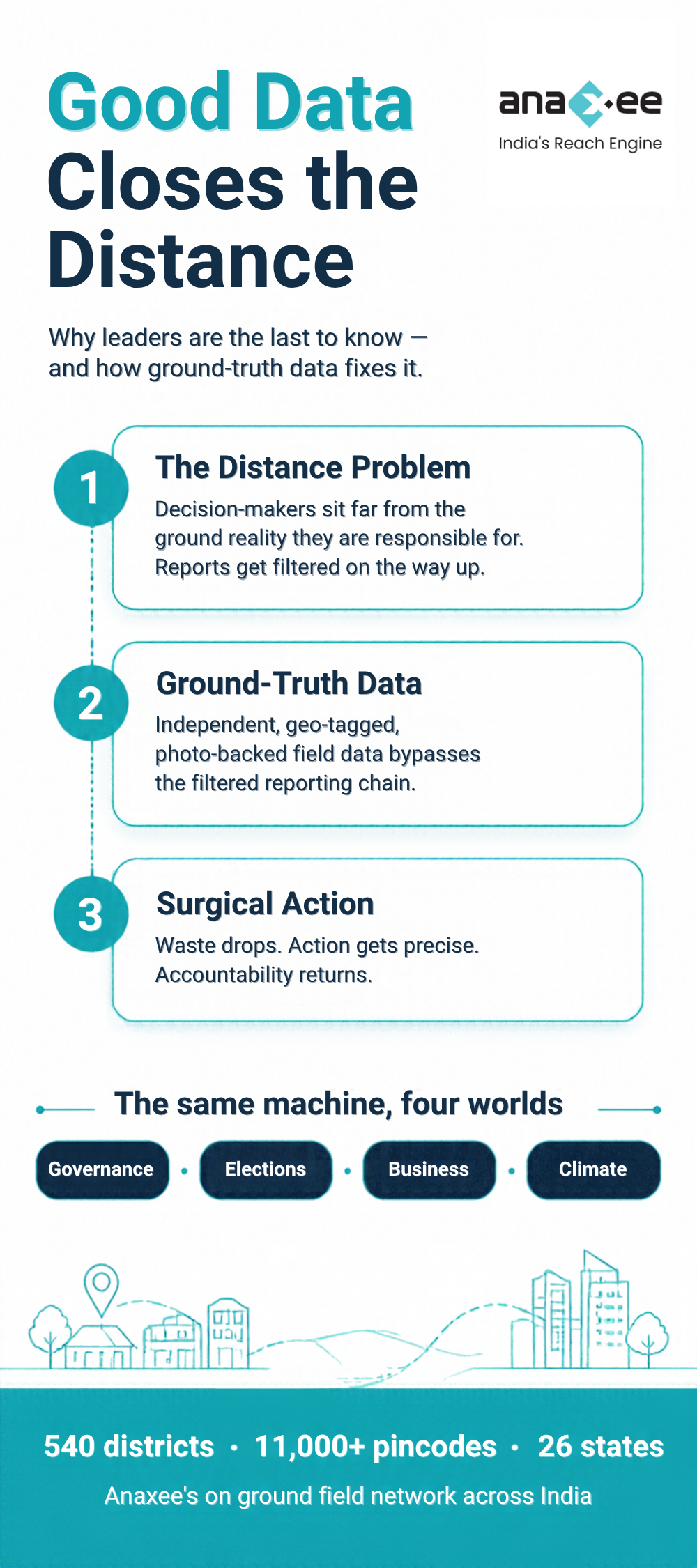
Anaxee infographic: good data closes the distance between leaders and ground reality - the distance problem, ground-truth data, surgical action - across governance, elections, business and climate. 540 districts, 11,000+ pincodes, 26 states.
How good data closes the distance between decision-makers and the ground reality they answer for — the same machine across governance, elections, business and climate. Source: Anaxee Digital Runners.

The distance problem

Every leader is responsible for a reality they cannot personally see. A retail chief answers for what happens in five thousand shops she will never walk into. A welfare minister answers for benefits reaching villages he will never set foot in. A candidate answers for the mood of millions he will never meet. None of them can be everywhere, so they rely on a chain of people to tell them what is going on — area managers, field officers, party workers, distributors, contractors.

The trouble is that every rung of that ladder has an interest in how the truth looks from above. The weak store does not want head office to know it is weak. The officer wants the scheme to look like it is working. The local worker wants the candidate to think the booth is safe. Nobody has to lie outright; they just each shade the picture a little in their own favour. Stacked up over five or six rungs, a lot of small shadings become a completely wrong picture. Bureaucracy and office politics are not side effects of this problem — they are the problem. Red tape, siloed information and competing interests are exactly what turn a clear ground reality into fog on the way up.

What actually closes the distance

The fix is not more reports, and it is not a prettier dashboard full of vanity numbers. It is ground truth: a direct, independent read of what is actually happening on the ground — captured at the source, with a time and a place attached, by someone who has no stake in making it look good. The two words that matter are direct and independent. Direct, so it did not climb the ladder and get shaded on the way. Independent, so the person collecting it is not the same person being judged by it.

When a leader can see the ground that way, three things change — and they are the same three things whether you run a company, a state or a campaign:

  • Waste drops. Money stops flowing to the wrong priorities, because you can finally see which ones are actually working and which only look good on paper.
  • Action gets surgical. Instead of spraying effort everywhere, you fix the one district, the one shelf, the one booth that needs it. Precision beats scale once you can see clearly.
  • Accountability returns. A number you can trace to a real place and a real moment is a number that cannot be spun. The ladder loses its power to hide.

The same machine, four different worlds

What makes this idea worth writing down is that it is not really four ideas. It is one capability — trustworthy ground truth — doing the same job in four fields that rarely get discussed together:

Field The distance What ground-truth data unlocks
Governance A government cannot see every village its schemes are meant to reach. Welfare that actually lands on the right people; money redirected from show to substance. (Estonia, India’s Aspirational Districts, Togo’s data-targeted cash transfers.)
Elections A campaign cannot personally hear millions of voters. Hearing the ground booth by booth, so a candidate plans with reality instead of noise. (Obama 2012; India’s booth-level campaign data.)
Business Top management cannot watch every shop, plant and market. An un-spun view of the market, past the sales team’s own reporting line. The boss stops being the last to know.
Climate A funder cannot see whether a distant tree actually survived. Claims that can be measured and trusted instead of greenwashed — the difference between a pledge and proof.

In each case the enemy is the same: distance, dressed up as hierarchy. And in each case the thing that beats it is the same: data that comes straight from the ground and owes nothing to the people being measured. We will take each of these four worlds apart in its own piece — what the evidence actually shows, and where it has gone wrong — but the thread running through all of them is this one.

A useful test for any dashboard: ask where the worst number on it came from, and how many people touched it before it reached you. If the answer is “a lot,” you are not looking at the ground. You are looking at the ladder’s opinion of the ground.

Why this is really a productivity story

Strip away the fields and this is, at bottom, about productivity. Whoever can see reality clearly and act on it quickly will out-perform whoever is deciding in fog — every time, in any domain. A company that can see its own market makes fewer expensive mistakes. A government that can see its own programmes spends public money where it changes lives instead of where it photographs well. A campaign that can hear its own voters stops wasting effort on the already-decided. The gap between the two is not talent. It is the quality and the honesty of the information reaching the top.

That is also where the hard part lives. The analysis is rarely the bottleneck — there is no shortage of people who can read a chart. The bottleneck is whether the data underneath the chart is true: whether it came from the ground or from the ladder. Getting trustworthy data out of thousands of scattered places — villages, shops, farms, booths — is a genuinely hard, physical problem, and it is the one most organisations quietly skip. It is also, as it happens, the problem we spend our days on.

A note on where we come from: Anaxee runs an independent, tech-enabled field network across India — 540 districts, 11,000+ pincodes, 26 states — built to collect exactly this kind of ground truth and put it on a decision-maker’s dashboard. We write about this because we see the distance problem every day, from the ground up. If the idea is useful to you, the rest of the series goes field by field.

How our field reach works

Frequently asked questions

What is data-driven decision-making, in plain terms?
It is making choices from evidence about what is actually happening, rather than from intuition, hierarchy or the most confident voice in the room. The crucial part is the quality of the evidence: data that comes directly from the ground, independent of the people being judged by it, beats a polished report that has passed through many hands.
Why are leaders often the last to know?
Because information climbs a chain of people before it reaches them, and each person in the chain has an incentive to make the picture look better than it is. Over several levels, small distortions add up to a wrong picture. This is the “distance problem” — and it is why independent, ground-level data matters so much.
How does data improve governance and public services?
It lets a government see where schemes are and are not working, target welfare to the people who actually need it, redirect money from low-impact to high-impact areas, and hold delivery accountable. Real examples include Estonia’s digital public services, India’s Aspirational Districts Programme, and Togo’s use of mobile and satellite data to target emergency cash transfers.
Is data useful in elections and politics?
Yes — mainly as a way to hear the ground at scale and plan around it, rather than as a magic persuasion machine. The Obama 2012 campaign is the famous analytics case; in India, booth-level data drives campaign planning. Notably, some of the most respected strategists argue that on-ground listening matters far more than remote number-crunching.
Why is “ground truth” harder than it sounds?
Because the data that matters usually lives in thousands of scattered physical places — farms, shops, villages, booths — with no system of record. Getting it reliably, at scale, means actually reaching those places and capturing evidence there, which is a field problem, not a software problem. That is why most organisations have good analysts but weak ground data.
About this piece. This is the opening essay in a series on how trustworthy, ground-level data changes decision-making — across governance, elections, business and climate. Real-world examples are drawn from public sources and attributed in the individual pieces. It reflects the view of Anaxee Digital Runners, an independent field data and verification company, and is offered as perspective, not advice.

Panna Pramukh, Explained: How Page-Level Booth Management Works at Scale

The Panna Pramukh model organises outreach one page of the electoral roll at a time. Here is how page-level booth management works, why it is hard to run at scale, and how a tech-enabled field network makes it faster and verifiable.

Across India, one of the most granular ways to organise citizen outreach is the Panna Pramukh model — literally, a ‘page in-charge’. The idea is simple: take the electoral roll, break it into single pages, and make one trusted local person responsible for the handful of voters on each page. It is a grassroots organising method used, in various forms, across the political spectrum and by civic bodies alike.

This guide explains, neutrally, how page-level booth management actually works — what a Panna Pramukh does, why coordinating thousands of them is the real challenge, and how a trained, tech-enabled field network changes the logistics of reaching every citizen on the list.

What is a Panna Pramukh?

A ‘panna’ is one page of the electoral roll. A single page typically lists about 30 voters per side — roughly 60 voters counting both sides. A Panna Pramukh is the person assigned to that one page: their job is to know those ~60 citizens, make sure they have the information they need, and help ensure they can actually turn out and vote.

It is the smallest, most human unit of outreach there is. Instead of a campaign or a programme addressing a whole constituency at once, it reaches people in groups of sixty — through someone local who can knock on the right doors.

Why organise at the ‘page’ level at all?

Because reach at scale usually fails at the last mile. Mass media and digital ads create awareness, but the final step — making sure a specific household is informed, registered and able to participate — happens person to person. Page-level organising exists so that no voter is just a number in a spreadsheet: each one sits on a page that someone is accountable for.

This is the same last-mile logic behind Anaxee’s wider work; for that argument in a marketing context, see our note on hyperlocal amplification.

The real challenge: scale

One page sounds manageable. One constituency does not. A single assembly seat can hold thousands of pannas.

As an illustration, take a large urban assembly segment with around 2,85,000 voters. At roughly 60 voters per page-lead, that is about 4,750 Panna Pramukhs — for a single seat. Spread them across several assembly segments, 300+ polling booths and thousands of households, and the task is no longer ‘knock on doors’. It becomes coordinating, training and tracking thousands of people at once — and knowing, in real time, which pages are actually covered and which are not.

Where the traditional model strains

Run manually, page-level organising hits predictable limits:

  • It is volunteer-dependent, so coverage is uneven.
  • Mapping and updating one constituency can take 60–90 days.
  • Reporting is slow and hard to verify — a page marked ‘done’ on paper may never have been visited.
  • There is no central, live view of where the gaps are.

The method is sound. The logistics of running it across thousands of pages, accountably, are where it breaks.

How a tech-enabled field network changes the logistics

This is where a trained, on-demand field network fits — not to change what page-level outreach is, but to make it faster, verifiable and measurable. Anaxee runs a network of 40,000+ trained Digital Runners across 540 districts, 26 states and 11,000+ pincodes, each working through a mobile app and a central dashboard. Applied to booth-level outreach, that means:

  • Coverage, faster. In Anaxee’s model, mapping a constituency becomes a 15–20 day exercise rather than two to three months, because the field force already exists and is deployed on demand.
  • Verifiable work. Every visit is geo-tagged, timestamped and backed by photos through the app — so ‘covered’ means actually covered, not just reported.
  • A live view. A central dashboard shows which pages, booths and clusters are done and which still have gaps, in real time, instead of waiting for end-of-cycle paperwork.
  • Last-mile reach. Each Runner can cover a cluster of roughly 50–100 citizens using verified lists, in exactly the Tier 2, 3 and 4 areas where coordination is hardest.

In short: the Panna Pramukh model answers ‘who reaches each voter’. A tech-enabled field network answers ‘how do you run thousands of them at once, and prove the work got done’.

Traditional vs tech-enabled: the logistics

  Traditional model Tech-enabled field network
Who does the work Local volunteers Trained, on-demand Digital Runners
Time to map a constituency 60–90 days 15–20 days (Anaxee’s model)
Proof of work Paper reports, hard to verify Geo-tagged, timestamped, photo-backed
Visibility End-of-cycle, patchy Live dashboard of coverage and gaps
Reach Strong only where volunteers exist 540 districts, including hard-to-reach Tier 2–4

The same muscle works far beyond elections

Page-level, last-mile reach is not only an election tool. The same trained field network delivers:

  • Government scheme awareness — making sure eligible citizens actually know about and can access a programme.
  • Welfare and delivery verification — confirming, on the ground, that benefits reached the right households.
  • Voter registration and awareness drives — the civic, participation-raising side of outreach.
  • Public-health outreach — the model Anaxee ran in Project Swaraksha, where its runners counselled nearly 30 lakh citizens and facilitated over 17 lakh vaccinations across 19 states.
  • Large-scale citizen surveys — structured, geo-tagged data from places that are otherwise hard to reach.

A note on neutrality

Anaxee operates as neutral last-mile infrastructure. The network is available to any campaign, political party, government department or civic organisation on equal terms, and every engagement is run within the law and the Election Commission of India’s norms. Anaxee’s role is reach and verifiable execution — not persuasion, and not any party’s advantage.

Frequently asked questions

What exactly is a panna and a Panna Pramukh?

A panna is one page of the electoral roll (about 30 voters a side). A Panna Pramukh is the local person responsible for the roughly 60 voters on that page — knowing them, informing them, and helping ensure they can vote.

How many Panna Pramukhs does one constituency need?

It depends on the voter count. As a rough illustration, a seat with ~2.85 lakh voters, at ~60 voters per page-lead, needs around 4,750 — which is why coordination, not the idea itself, is the hard part.

Is this only useful for elections?

No. The same page-level, last-mile reach is used for government scheme awareness, welfare verification, public-health drives and large-scale surveys.

How is a tech-enabled model different from the traditional one?

The traditional model is manual and slow to verify. A tech-enabled field network adds speed (15–20 days to map a constituency, in Anaxee’s model), geo-tagged proof of every visit, and a live dashboard of coverage and gaps.

Is it party-affiliated?

No. It is neutral infrastructure available to any campaign, party, government body or civic organisation, operated within the law.

Planning outreach at this scale?

If you need to reach citizens page by page, booth by booth, with work you can actually verify, that is what a last-mile field network is built for. See Anaxee’s election & civic field-outreach service, explore what Anaxee does, or talk to our team about coverage in your priority districts.