BLOG
What Is a Market Entry Strategy? Modes, Examples & Entering the India Market

 About Anaxee
40,000+ Digital Runners · 540 districts · 26 states · 11,000+ pincodes of reach
Every new market looks like an opportunity on a slide. The ones that work are the ones with a plan behind them. A market entry strategy is that plan: how a company will take its product into a market it does not yet sell in, and win there rather than burn cash learning the hard way. Get the entry mode, the pricing and the on-ground execution right and you build a real position; get them wrong and a good product stalls at the border of the market.
This guide explains what a market entry strategy is, the main modes of entry, the factors that decide which one fits, and what entering a market actually takes in India.
What is a market entry strategy?
A market entry strategy is a structured plan for delivering a product or service into a new market and establishing a position there. It brings together a few decisions: which market (or segment) to enter and in what order, the value proposition and pricing for that market, the barriers to entry, and — the decision everything else hangs on — the mode of entry: how you actually operate in the market.
The main modes of market entry
Entry modes trade off speed, control and cost. The common ones, from lowest commitment to highest:
Grouped simply, most entry plans come down to four choices: export into the market, license or franchise the offer, partner through a joint venture, or build or buy a local operation. Each is a different balance of speed, control and cost — and the right one depends on how concentrated the market is, how much control you need over the brand, and how much you can invest.
What decides the right entry strategy
Entering the India market: the real barrier is the last mile
For most brands entering India — whether a foreign company coming in, or an Indian brand pushing into a new state or into Bharat beyond the metros — the entry-mode decision gets most of the attention, and it is the easy part. The hard part shows up after: a brand picks a distributor, lists the product, runs some advertising, and then discovers the market is far larger and far more scattered than the plan assumed. Demand exists in thousands of towns the distributor never reaches; the brand has no feet on the ground to find out what is actually happening; and the entry quietly stalls at the top 50 districts.
The brands that enter India well treat it as a phased, evidence-led rollout: map and size the market, pilot in one region to prove reach and unit economics before committing nationally, then scale on what actually worked. That only works if someone can physically reach the market, town by town, and feed back the truth.
Entering India, or a new market within it?
Anaxee runs the on-ground half of a market entry — mapping the market, onboarding the channel and proving reach with a pilot before you scale. See the go-to-market playbook for Bharat, or talk to our team.
Where technology and AI help
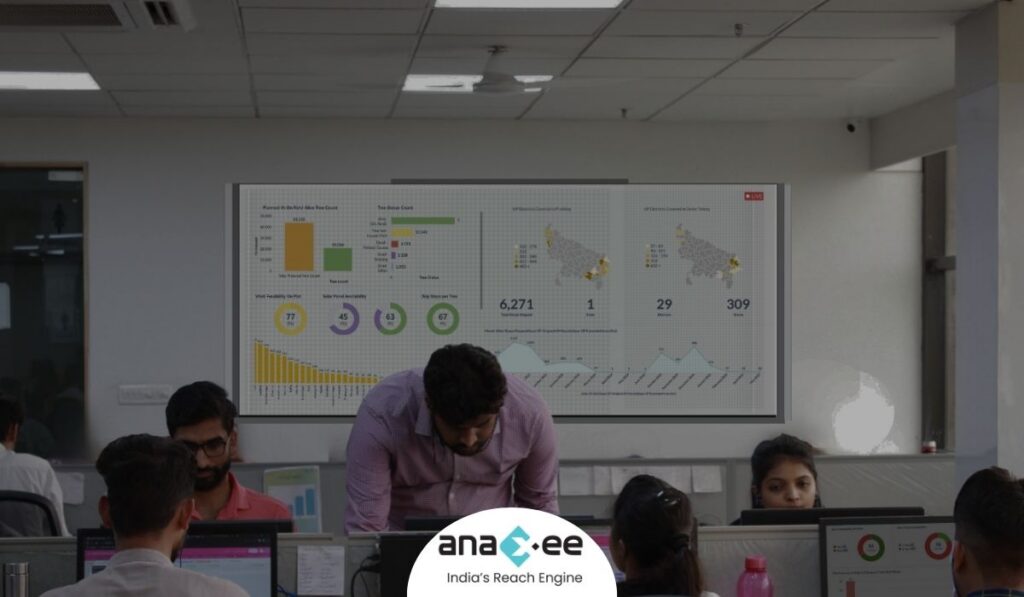
A market you have just entered is the one you know least about. Field teams map every target outlet and prospect on an app; each visit is geo-tagged, time-stamped and photographed, flowing to a live dashboard and API, and AI reads the field photos to flag visits that do not add up. So instead of guessing how the entry is going from a distributor’s monthly report, a brand can see its new market shop by shop, town by town, from week one.
How Anaxee helps you enter the India market
Deciding the entry mode is a boardroom call; executing it is a last-mile one. Anaxee — India’s Reach Engine, a National Startup Award winner — is the execution layer for a market entry: 40,000+ Digital Runners across 540 districts and 11,000+ pincodes who map and size the market, onboard distributors and retailers, run a pilot region so you prove reach before scaling, and feed it all to a live dashboard. It is how a brand turns an entry plan into real presence on the ground. See the go-to-market playbook for Bharat, the Bharat market opportunity, how we build and manage distribution, run field sales, and the wider distribution strategy behind it.
Proof on the groundMarket mapping, channel onboarding and pilot-to-scale rollouts run across India for consumer, durable, auto and agri brands entering new markets. See all case studies →
What happens when you reach out to Anaxee
- Tell us the market — the product, the geographies and the channel you want to build — by form, WhatsApp or a call.
- A real person calls back — our Indore team, within one working day.
- We scope a pilot — one market mapped and activated, so you see the coverage and the data quality before you scale nationally.
A 150+ person team in Indore and 40,000+ Digital Runners on the ground — your enquiry reaches people who run field programmes every day, not an inbox that goes quiet.
Frequently asked questions
What is a market entry strategy?
What are the main modes of market entry?
What are the four market entry strategies?
What is the difference between a market entry strategy and a go-to-market strategy?
How should a foreign brand enter the India market?
How does Anaxee help with market entry in India?
The bottom line
A market entry strategy is the plan for taking your product into a new market and winning there — the mode of entry, the pricing, the barriers and the reach. In India especially, the strategy on paper is the easy half; the hard half is physically reaching a vast, scattered market and seeing what is actually happening. That execution is exactly what Anaxee was built for.
Ready to turn a market entry plan into real presence?
Tell us the market and we will scope a pilot — one region mapped and activated, so you see the reach before you scale.