BLOG
What Is Route to Market (RTM)? Models, Strategy & RTM vs GTM
 About Anaxee
40,000+ Digital Runners · 540 districts · 26 states · 11,000+ pincodes of reach
A brand can have the right product, the right price and the right ad — and still fail because it never reaches the shelf. How it reaches the shelf has a name: route to market, or RTM. It is the term chief sales and marketing officers use for the whole machine that moves a product from the factory to the customer: the channels, the partners who run them, and the feet that cover the outlets. Two brands with the same product can win or lose on RTM alone — because one gets consistent distribution and execution, and the other does not.
This guide explains what route to market is, the common RTM models, how RTM differs from go-to-market and distribution strategy, and what running an RTM takes in India.
What is route to market (RTM)?
Route to market is the path — and the choices behind it — that a product takes from the producer to the end customer: which channels it sells through, which partners operate each channel, which types of outlet each partner serves, in which territories, and how the field force drives orders and visibility. It is the selling and distribution part of the supply chain, and one of the biggest things deciding a brand’s cost-to-serve and market reach.
The common route-to-market models
Route to market in India: a long, multi-tier chain
Indian RTM is shaped by a vast, fragmented general-trade base — millions of independent retailers reached through a multi-tier chain: CFA → super-stockist → distributor → wholesaler → retailer. Each tier adds margin but extends reach. On top of that, brands tune the field model (a pre-sales beat where a rep takes orders ahead of delivery, versus van sales where stock travels with the rep), and decide which towns to service directly versus through wholesalers. Every one of these choices is really the same trade-off: more reach versus lower cost-to-serve. The brands that win keep tuning that balance with data, not assumption.
Route to market vs go-to-market vs distribution strategy
| Go-to-market | Route to market | Distribution strategy | |
|---|---|---|---|
| What it is | The whole plan to launch and sell a product | The sell-and-deliver path within it | The channel & coverage plan |
| Answers | Who to target, positioning, pricing — and the route | Which channels & partners sell and deliver, and how the field covers each outlet | Direct / indirect / hybrid, and how widely to sell |
| Think of it as | The strategy | The operating engine | The channel map |
In short: RTM is a component of GTM — the part that actually moves the product — and it is wider than distribution strategy, because it decides not just the channels but who sells to each outlet, on what terms, and how the field team covers it. See our full guides to the go-to-market strategy and the distribution strategy.
Every new geography needs its own route to market
An RTM that works in the South may not work in the North. Trade structures, distributor strength, languages and buying habits differ state to state, so a brand expanding into new regions of India effectively has to design and build a fresh route to market in each one — find the right partners, map the outlets, and put feet on the ground — before it can scale. That build is exactly the work most brands have no team for.
Need to build or run your route to market in India?
Anaxee is the on-ground execution layer for an RTM — mapping outlets, onboarding the channel, running the beat and feeding it to a live dashboard, in any geography. See the go-to-market playbook for Bharat, or talk to our team.
Where technology and AI change the game
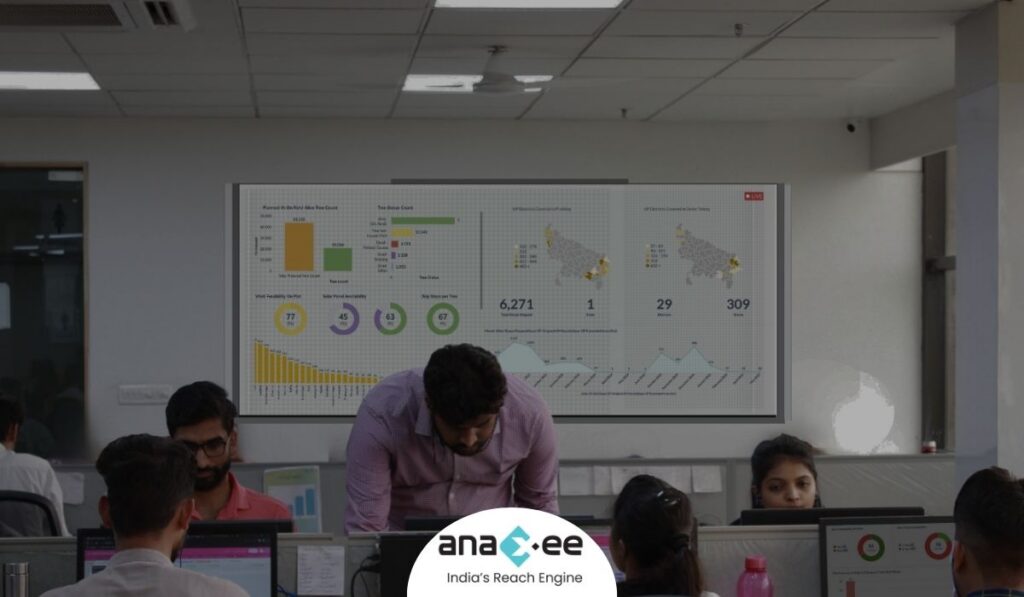
A route to market is invisible without data — and that is where most RTMs fail. Field teams map every outlet on an app; each visit (order taken, shelf photographed, outlet profiled) is geo-tagged and time-stamped to a live dashboard and API, and AI reads the field photos to keep the data honest. For the first time a brand can see its RTM the way it sees its billing — coverage gaps, overlaps, cost-to-serve by geography — and redesign the route around what the data actually shows.
How Anaxee helps you run your route to market
An RTM on a slide earns nothing until someone reaches the outlets. Anaxee — India’s Reach Engine, a National Startup Award winner — is that execution layer: 40,000+ Digital Runners across 540 districts and 11,000+ pincodes who map the market, onboard distributors and retailers, run a regular beat and feed it all to a live dashboard — so the indirect route that reaches India’s long tail is one you can finally see and steer. It is the execution half of a distribution strategy and the go-to-market playbook, and the engine behind any market expansion. See how we strengthen distributor networks, reach rural retailers and run field sales.
Proof on the groundMarket mapping, channel onboarding and field execution run across India — the on-ground route to market for consumer, durable, auto and agri brands. See all case studies →
What happens when you reach out to Anaxee
- Tell us the market — the product, the geographies and the channel you want to build — by form, WhatsApp or a call.
- A real person calls back — our Indore team, within one working day.
- We scope a pilot — one market mapped and activated, so you see the coverage and the data quality before you scale nationally.
A 150+ person team in Indore and 40,000+ Digital Runners on the ground — your enquiry reaches people who run field programmes every day, not an inbox that goes quiet.
Frequently asked questions
What is the full form of RTM?
What is route to market?
What is the difference between RTM and GTM?
Is route to market the same as a distribution strategy?
What are the route-to-market models?
How does Anaxee help with route to market in India?
The bottom line
Route to market is how your product actually reaches its customers — the channels, the partners and the feet behind the plan. The design is the easy half; executing and seeing it, across India’s millions of scattered outlets, is where brands win or lose. That on-ground execution and visibility is exactly what Anaxee was built for.
Ready to make your route to market real?
Tell us the product and the geography and we will scope a pilot — one territory where your RTM is mapped, activated and tracked live.